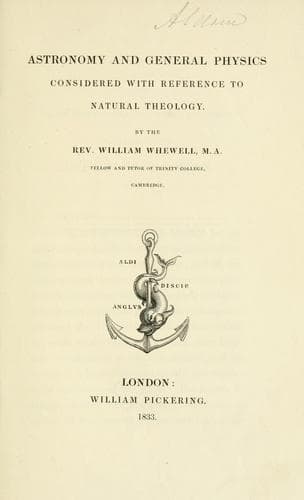
Astronomy and General Physics Considered with Reference to Natural Theology — John Shaqi
Astronomy and General Physics Considered with Reference to Natural TheologyWhewell, William
Religion
Astronomy and General Physics Considered with Reference to Natural Theology
Whewell, William
Astronomy; Cosmic physics; Natural theology
globe flower. And when these fail us, the reindeer moss still makes
the country habitable for animals and man.
We have thus a variety in the laws of vegetable organization
remarkably adapted to the variety of climates; and by this
adaptation the globe is clothed with vegetation and peopled with
animals from pole to pole, while without such an adaptation
vegetable and animal life must have been confined almost, or
entirely, to some narrow zone on the earth’s surface. We conceive
that we see here the evidence of a wise and benevolent intention,
overcoming the varying difficulties, or employing the varying
resources of the elements, with an inexhaustible fertility of
contrivance, a constant tendency to diffuse life and well being.
2. One of the great uses to which the vegetable wealth of the earth
is applied, is the support of man, whom it provides with food and
clothing; and the adaptation of tribes of indigenous vegetables
to every climate has, we cannot but believe, a reference to the
intention that the human race should be diffused over the whole
globe. But this end is not answered by indigenous vegetables alone;
and in the variety of vegetables capable of being _cultivated_ with
advantage in various countries, we conceive that we find evidence
of an additional adaptation of the scheme of organic life to the
system of the elements.
The cultivated vegetables, which form the necessaries or luxuries
of human life, are each confined within limits, narrow, when
compared with the whole surface of the earth; yet almost every part
of the earth’s surface is capable of being abundantly covered with
one kind or other of these. When one class fails, another appears
in its place. Thus corn, wine, and oil, have each its boundaries.
Wheat extends through the old Continent, from England to Thibet:
but it stops soon in going northwards, and is not found to succeed
in the west of Scotland. Nor does it thrive better in the torrid
zone than in the polar regions: within the tropics, wheat, barley
and oats are not cultivated, excepting in situations considerably
above the level of the sea: the inhabitants of those countries have
other species of grain, or other food. The cultivation of the vine
succeeds only in countries where the annual temperature is between
50 and 63 degrees. In both hemispheres, the profitable culture
of this plant ceases within 30 degrees of the equator, unless in
elevated situations, or in islands, as Teneriffe. The limits of the
cultivation of maize and of olives in France are parallel to those
which bound the vine and corn in succession to the north. In the
north of Italy, west of Milan, we first meet with the cultivation
of rice; which extends over all the southern part of Asia, wherever
the land can be at pleasure covered with water. In great part of
Africa millet is one of the principal kinds of grain.
Public-domain text, read in full here on John Shaqi.
Reviews
Reviews
No reviews yet
Be the first to share your thoughts on this work.
Join the Discussion
Join the discussion
Sign in to leave a comment or review.
Sign InorCreate an account