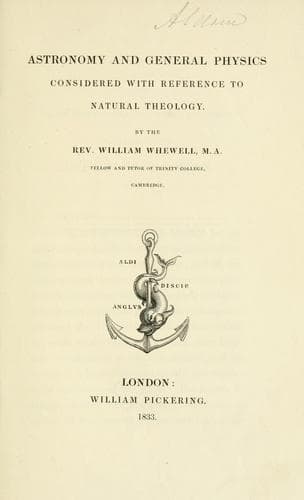
Astronomy and General Physics Considered with Reference to Natural TheologyWhewell, William
Religion
Astronomy and General Physics Considered with Reference to Natural Theology
Whewell, William
Astronomy; Cosmic physics; Natural theology
If the atmosphere be considered as a vast machine, it is
difficult to form any just conception of the profound skill and
comprehensiveness of design which it displays. It diffuses and
tempers the heat of different climates; for this purpose it
performs a circulation occupying the whole range from the pole to
the equator; and while it is doing this, it executes many smaller
circuits between the sea and the land. At the same time, it is
the means of forming clouds and rain, and for this purpose, a
perpetual circulation of the watery part of the atmosphere goes on
between its lower and upper regions. Besides this complication of
circuits, it exercises a more irregular agency, in the occasional
winds which blow from all quarters, tending perpetually to restore
the equilibrium of heat and moisture. But this incessant and
multiplied activity discharges only a part of the functions of the
air. It is, moreover, the most important and universal material of
the growth and sustenance of plants and animals; and is for this
purpose every where present and almost uniform in its quantity.
With all its local motion, it has also the office of a medium
of communication between intelligent creatures, which office it
performs by another set of motions, entirely different both from
the circulation and the occasional movements already mentioned;
these different kinds of motions not interfering materially with
each other: and this last purpose, so remote from the others
in its nature, it answers in a manner so perfect and so easy,
that we cannot imagine that the object could have been more
completely attained, if this had been the sole purpose for which
the atmosphere had been created. With all these qualities, this
extraordinary part of our terrestrial system is scarcely ever in
the way: and when we have occasion to do so, we put forth our hand
and push it aside, without being aware of its being near us.
We may add, that it is, in addition to all that we have hitherto
noticed, a constant source of utility and beauty in its effects
on light. Without air we should see nothing, except objects on
which the sun’s rays fell, directly or by reflection. It is the
atmosphere which converts sunbeams into daylight, and fills the
space in which we are with illumination.
The contemplation of the atmosphere, as a machine which answers all
these purposes, is well suited to impress upon us the strongest
conviction of the most refined, far-seeing, and far-ruling
contrivance. It seems impossible to suppose that these various
properties were so bestowed and so combined, any otherwise than by
a beneficent and intelligent Being, able and willing to diffuse
organization, life, health, and enjoyment through all parts of
the visible world; possessing a fertility of means which no
multiplicity of objects could exhaust, and a discrimination of
consequences which no complication of conditions could embarrass.
CHAPTER XVI.
_Light._
Public-domain text, read in full here on John Shaqi.
Reviews
Reviews
No reviews yet
Be the first to share your thoughts on this work.
Elsewhere in the archive
Join the Discussion
Join the discussion
Sign in to leave a comment or review.
Sign InorCreate an account