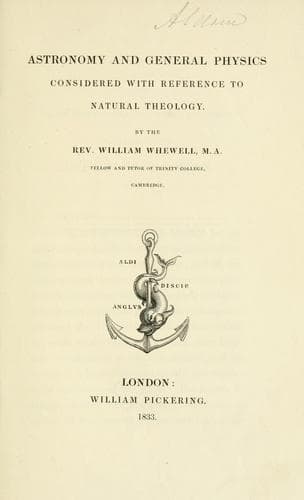
Astronomy and General Physics Considered with Reference to Natural TheologyWhewell, William
Religion
Astronomy and General Physics Considered with Reference to Natural Theology
Whewell, William
Astronomy; Cosmic physics; Natural theology
Besides the hearing and sound there is another mode by which we
become sensible of the impressions of external objects, namely,
sight and light. This subject also offers some observations bearing
on our present purpose.
It has been declared by writers on Natural Theology, that the
human eye exhibits such evidence of design and skill in its
construction, that no one, who considers it attentively, can resist
this impression: nor does this appear to be saying too much. It
must, at the same time, be obvious that this construction of the
eye could not answer its purposes, except the constitution of light
corresponded to it. Light is an element of the most peculiar kind
and properties, and such an element can hardly be conceived to have
been placed in the universe without a regard to its operation and
functions. As the eye is made for light, so light must have been
made, at least among other ends, for the eye.
1. We must expect to comprehend imperfectly only the mechanism
of the elements. Still, we have endeavoured to show that in some
instances the arrangements by which their purposes are effected
are, to a certain extent, intelligible. In order to explain,
however, in what manner light answers those ends which appear to us
its principal ones, we must know something of the nature of light.
There have, hitherto, been, among men of science, two prevailing
opinions upon this subject: some considering light as consisting
in the emission of luminous particles; others accounting for
its phenomena by the propagation of vibrations through a highly
subtle and elastic _ether_. The former opinion has, till lately,
been most generally entertained in this country, having been the
hypothesis on which Newton made his calculations; the latter is
the one to which most of those persons have been led, who, in
recent times, have endeavoured to deduce general conclusions from
the newly discovered phenomena of light. Among these persons, the
_theory of undulations_ is conceived to be established in nearly
the same manner, and almost as certainly, as the doctrine of
universal gravitation; namely, by a series of laws inferred from
numerous facts, which, proceeding from different sets of phenomena,
are found to converge to one common view; and by calculations
founded upon the theory, which, indicating new and untried facts,
are found to agree exactly with experiment.
We cannot here introduce a sketch of the progress by which the
phenomena have thus led to the acceptance of the theory of
undulations. But this theory appears to have such claims to our
assent, that the views which we have to offer with regard to the
design exercised in the adaptation, of light to its purposes, will
depend on the undulatory theory, so far as they depend on theory at
all.[15]
Public-domain text, read in full here on John Shaqi.
Reviews
Reviews
No reviews yet
Be the first to share your thoughts on this work.
Elsewhere in the archive
Join the Discussion
Join the discussion
Sign in to leave a comment or review.
Sign InorCreate an account