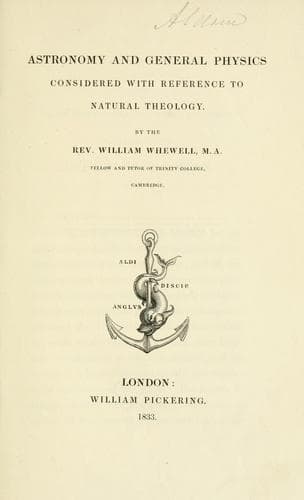
Astronomy and General Physics Considered with Reference to Natural TheologyWhewell, William
Religion
Astronomy and General Physics Considered with Reference to Natural Theology
Whewell, William
Astronomy; Cosmic physics; Natural theology
Suppose these substances in existence; in contact, in
due proportion to each other. Is _this_ a world, or at least our
world? No more than the mine and the forest are the ship of war and
the factory. These elements, with their constitution perfect, and
their proportion suitable, are still a mere chaos. They must be put
in their places. They must not be where their own properties would
place them. They must be made to assume a particular arrangement,
or we can have no regular and permanent course of nature. This
arrangement must again have additional peculiarities, or we can
have no organic portion of the world. The millions of millions
of particles which the world contains, must be finished up in
as complete a manner, and fitted into their places with as much
nicety, as the most delicate wheel or spring in a piece of human
machinery. What are the habits of thought to which it can appear
possible that this could take place without design, intention,
intelligence, purpose, knowledge?
In what has just been said, we have spoken only of the constitution
of the inorganic part of the universe. The mechanism, if we may
so call it, of vegetable and animal life, is so far beyond our
comprehension, that though some of the same observations might be
applied to it, we do not dwell upon the subject. We know that in
these processes also, the mechanical and chemical properties of
matter are necessary, but we know too that these alone will not
account for the phenomena of life. There is something more than
these. The lowest stage of vitality and irritability appears to
carry us beyond mechanism, beyond affinity. All that has been said
with regard to the exactness of the adjustments, the combination of
various means, the tendency to continuance, to preservation, is
applicable with additional force to the organic creation, so far
as we can perceive the means employed. These, however, belong to a
different province of the subject, and must be left to other hands.
BOOK II.
COSMICAL ARRANGEMENTS.
When we turn our attention to the larger portions of the universe,
the sun, the planets, and the earth as one of them, the moon and
other satellites, the fixed stars and other heavenly bodies;--the
views which we obtain concerning their mutual relations,
arrangement and movements, are called, as we have already
stated, _cosmical_ views. These views will, we conceive, afford
us indications of the wisdom and care of the Power by which the
objects which we thus consider, were created and are preserved: and
we shall now proceed to point out some circumstances in which these
attributes may be traced.
Public-domain text, read in full here on John Shaqi.
Reviews
Reviews
No reviews yet
Be the first to share your thoughts on this work.
Elsewhere in the archive
Join the Discussion
Join the discussion
Sign in to leave a comment or review.
Sign InorCreate an account