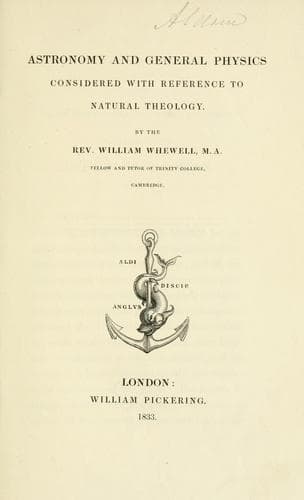
Astronomy and General Physics Considered with Reference to Natural TheologyWhewell, William
Religion
Astronomy and General Physics Considered with Reference to Natural Theology
Whewell, William
Astronomy; Cosmic physics; Natural theology
than thousands, and, in some instances, millions of years; and
hence it is, that some of these apparent derangements have been
going on in the same direction since the beginning of the history
of the world. But the restoration is in the sequel as complete as
the derangement; and in the meantime the disturbance never attains
a sufficient amount seriously to alter the adaptations of the
system.[17]
The same examination of the subject by which this is proved, points
out also the conditions on which this stability depends. “I have
succeeded in demonstrating,” says Laplace, “that whatever be the
masses of the planets, in consequence of the fact that they all
move in the same direction, in orbits of small eccentricity, and
slightly inclined to each other--their secular inequalities are
periodical and included within narrow limits; so that the planetary
system will only oscillate about a mean state, and will never
deviate from it except by a very small quantity. The ellipses of
the planets have been, and always will be, nearly circular. The
ecliptic will never coincide with the equator, and the entire
extent of the variation in its inclination cannot exceed three
degrees.”
There exists, therefore, it appears, in the solar system, a
provision for the permanent regularity of its motions; and this
provision is found in the fact that the orbits of the planets are
nearly circular, and nearly in the same plane, and the motions all
in the same direction, namely, from west to east.[18]
Now is it probable that the occurrence of these conditions of
stability in the disposition of the solar system is the work of
chance? Such a supposition appears to be quite inadmissible. Any
one of the orbits might have had any eccentricity.[19] In that
of Mercury, where it is much the greatest, it is only one-fifth.
How came it to pass that the orbits were not more elongated? A
little more or a little less velocity in their original motions
would have made them so. They might have had any inclination to
the ecliptic from _no_ degrees to 90 degrees. Mercury, which again
deviates most widely, is inclined 7¾ degrees, Venus 3¾, Saturn
2¾, Jupiter 1½, Mars 2. How came it that their motions are thus
contained within such a narrow strip of the sky? One, or any number
of them, might have moved from east to west: none of them does so.
And these circumstances, which appear to be, each in particular,
requisite for the stability of the system and the smallness of its
disturbances, are all found in combination. Does not this imply
both clear purpose and profound skill?
Public-domain text, read in full here on John Shaqi.
Reviews
Reviews
No reviews yet
Be the first to share your thoughts on this work.
Elsewhere in the archive
Join the Discussion
Join the discussion
Sign in to leave a comment or review.
Sign InorCreate an account