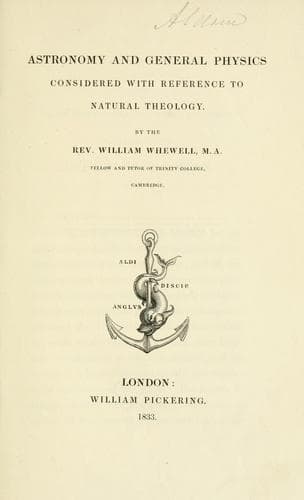
Astronomy and General Physics Considered with Reference to Natural TheologyWhewell, William
Religion
Astronomy and General Physics Considered with Reference to Natural Theology
Whewell, William
Astronomy; Cosmic physics; Natural theology
It is difficult to convey an adequate notion of the extreme
complexity of the task thus executed. A number of bodies, all
attracting each other, are to be projected in such a manner that
their revolutions shall be permanent and stable, their mutual
perturbations always small. If we return to the basin with its
rolling balls, by which we before represented the solar system, we
must complicate with new conditions the trial of skill which we
supposed. The problem must now be to project at once seven such
balls, all connected by strings which influence their movements, so
that each may hit its respective mark. And we must further suppose,
that the marks are to be hit after many thousand revolutions of the
balls. No one will imagine that this could be done by accident.
In fact it is allowed by all those who have considered this
subject, that such a coincidence of the existing state with the
mechanical requisites of permanency cannot be accidental. Laplace
has attempted to calculate the probability that it is not the
result of accident. He takes into account, in addition to the
motions which we have mentioned, the revolutions of the satellites
about their primaries, and of the sun and planets about their
axes: and he finds that there is a probability, far higher than
that which we have for the greater part of undoubted historical
events, that these appearances are not the effect of chance. “We
ought, therefore,” he says, “to believe, with at least the same
confidence, that a primitive cause has directed the planetary
motions.”
The solar system is thus, by the confession of all sides,
completely different from any thing which we might anticipate from
the casual operation of its known laws. The laws of motion are no
less obeyed to the letter in the most irregular than in the most
regular motions; no less in the varied circuit of the ball which
flies round a tennis court, than in the going of a clock; no less
in the fantastical jets and leaps which breakers make when they
burst in a corner of a rocky shore, than in the steady swell of the
open sea. The laws of motion alone will not produce the regularity
which we admire in the motions of the heavenly bodies. There must
be an original adjustment of the system on which these laws are
to act; a selection of the arbitrary quantities which they are to
involve; a primitive cause which shall dispose the elements in
due relation to each other, in order that regular recurrence may
accompany constant change; that perpetual motion may be combined
with perpetual stability; that derangements which go on increasing
for thousands or for millions of years may finally cure themselves;
and that the same laws which lead the planets slightly aside from
their paths, may narrowly limit their deviations, and bring them
back from their almost imperceptible wanderings.
Public-domain text, read in full here on John Shaqi.
Reviews
Reviews
No reviews yet
Be the first to share your thoughts on this work.
Elsewhere in the archive
Join the Discussion
Join the discussion
Sign in to leave a comment or review.
Sign InorCreate an account