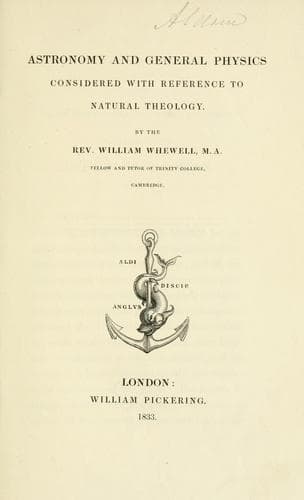
Astronomy and General Physics Considered with Reference to Natural TheologyWhewell, William
Religion
Astronomy and General Physics Considered with Reference to Natural Theology
Whewell, William
Astronomy; Cosmic physics; Natural theology
If a man does not deny that any possible peculiarity in the
disposition of the planets with regard to the sun could afford
evidence of a controlling and ordering purpose, it seems difficult
to imagine how he could look for evidence stronger than that
which there actually is. Of all the innumerable possible cases of
systems, governed by the existing laws of force and motion, that
one is selected which alone produces such a steadfast periodicity,
such a constant average of circumstances, as are, so far as we can
conceive, necessary conditions for the existence of organic and
sentient life. And this selection is so far from being an obvious
or easily discovered means to this end, that the most profound and
attentive consideration of the properties of space and number, with
all the appliances and aids we can obtain, are barely sufficient to
enable _us_ to see that the end is thus secured, and that it can be
secured in no other way. Surely the obvious impression which arises
from this view of the subject is, that the solar system, with
its adjustments, is the work of an intelligence, who perceives,
as self-evident, those truths, to which we attain painfully and
slowly, and after all imperfectly; who has employed in every part
of creation refined contrivances, which we can only with effort
understand; and who, in innumerable instances, exhibits to us what
we should look upon as remarkable difficulties remarkably overcome,
if it were not that, through the perfection of the provision, the
trace of the difficulty is almost obliterated.
CHAPTER IV.
_The Sun in the Centre._
The next circumstance which we shall notice as indicative of design
in the arrangement of the material portions of the solar system,
is the position of the sun, the source of light and heat, in the
centre of the system. This could hardly have occurred by any
thing which we can call chance. Let it be granted, that the law of
gravitation is established, and that we have a large mass, with
others much smaller in its comparative vicinity. The small bodies
may then move round the larger, but this will do nothing towards
making it a _sun_ to them. Their motions might take place, the
whole system remaining still utterly dark and cold, without day or
summer. In order that we may have something more than this blank
and dead assemblage of moving clods, the machine must be lighted
up and warmed. Some of the advantages of placing the lighting
and warming apparatus in the centre are obvious to us. It is in
this way only that we could have those regular periodical returns
of solar influence, which, as we have seen, are adapted to the
constitution of the living creation. And we can easily conceive,
that there may be other incongruities in a system with a travelling
sun, of which we can only conjecture the nature. No one probably
will doubt that the existing system, with the sun in the centre, is
better than any one of a different kind would be.
Public-domain text, read in full here on John Shaqi.
Reviews
Reviews
No reviews yet
Be the first to share your thoughts on this work.
Elsewhere in the archive
Join the Discussion
Join the discussion
Sign in to leave a comment or review.
Sign InorCreate an account