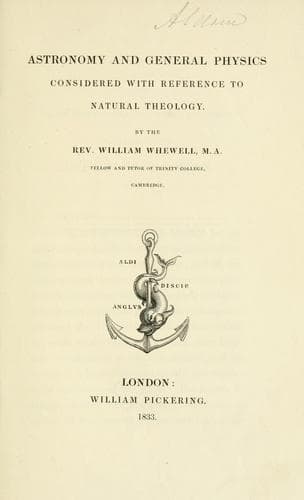
Astronomy and General Physics Considered with Reference to Natural TheologyWhewell, William
Religion
Astronomy and General Physics Considered with Reference to Natural Theology
Whewell, William
Astronomy; Cosmic physics; Natural theology
Now this lighting and warming by a central sun are something
superadded to the mere mechanical arrangements of the universe.
There is no apparent reason why the largest mass of gravitating
matter should diffuse inexhaustible supplies of light and heat in
all directions, while the other masses are merely passive, with
respect to such influences. There is no obvious connexion between
mass and luminousness, or temperature. No one, probably, will
contend that the materials of our system are necessarily luminous
or hot. According to the conjectures of astronomers, the heat and
light of the sun do not reside in its mass, but in a coating which
lies on its surface. If such a coating were fixed there by the
force of universal gravitation, how could we avoid having a similar
coating on the surface of the earth, and of all the other globes of
the system. If light consist in the vibrations of an ether, which
we have mentioned as a probable opinion, why has the sun alone the
power of exciting such vibrations? If light be the emission of
material particles, why does the sun alone emit such particles?
Similar questions may be asked, with regard to heat, whatever be
the theory we adopt on that subject. Here then we appear to find
marks of contrivance. The sun might become, we will suppose, the
centre of the motions of the planets by mere mechanical causes:
but what caused the centre of their motions to be also the source
of those vivifying influences? Allowing that no interposition was
requisite to regulate the revolutions of the system, yet observe
what a peculiar arrangement in other respects was necessary, in
order that these revolutions might produce days and seasons! The
machine will move of itself, we may grant: but who constructed the
machine, so that its movements might answer the purposes of life?
How was the candle placed upon the candlestick? How was the fire
deposited on the hearth, so that the comfort and well-being of the
family might be secured? Did these too fall into their places by
the casual operation of gravity? And, if not, is there not here
a clear evidence of intelligent design, of arrangement with a
benevolent end?
Public-domain text, read in full here on John Shaqi.
Reviews
Reviews
No reviews yet
Be the first to share your thoughts on this work.
Elsewhere in the archive
Join the Discussion
Join the discussion
Sign in to leave a comment or review.
Sign InorCreate an account