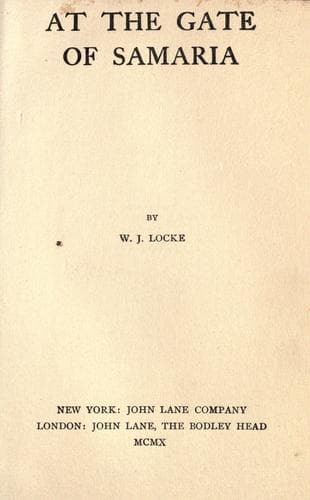
London (England) -- Fiction; Man-woman relationships -- Fiction; Women artists -- Fiction
“What on earth's the good of being a _woman?_” asked Clytie, with rather
unnecessary emphasis.
One of her studio companions had asked her to join a party at a theatre,
and her aunt had demurred on the ground that ladies ought not to go to
that particular house. It showed a certain knowledge of the world on
the old lady's part, but Clytie did not realise it, and although she
accepted the decision with good grace, it fretted her. These trivial
things fret even the wisest amongst us quite as much as the important
ones do.
Mrs. Farquharson did not reply, but continued placidly her usual Monday
morning's occupation of putting her music in order, while Clytie watched
her from the long rocking-chair where she was sitting, her hands clasped
behind her head.
“What's the good of being a woman when one has to pass half one's life
shut up in darkness? It's bad enough being a human being as it is, and
having to sleep the other half.”
“How old are you, my dear?” asked Mrs. Farquharson, looking at a song.
“You know,” replied Clytie. “Twenty.”
“Then how would you like to be a young man of twenty--or even
two-and-twenty? How would you like to be young Beaumont, for instance?
Do you think he knows so very much more than you do?”
“He's such a boy,” said Clytie.
“And you, my dear, are such a girl,” said Mrs. Farquharson, coming up
behind her chair and smoothing her cheeks. “But you are many years older
than he is--and likely to remain so. Do you know why we women like to
be women? Because we see so many things that men would give the eyes of
their heads to know. Hasn't it ever struck you that we are familiar with
a side of life that is almost forever hidden from men? And as for that
particular side that men have exclusively to themselves, it is neither
very pretty nor comfortful.”
“I suppose that is why men stop talking when one goes into the
smoking-room,” said Clytie. “You hear shouts of laughter outside the
door, and you think they must be having an awfully good time, and when
you appear in the doorway they seem to pull themselves together, and one
or two always look red and sheepish.”
“I should advise you to read the story of Bluebeard,” said Mrs.
Farquharson.
“You are just as bad as the rest,” cried Clytie, half laughing and half
vexed. “I never thought it of you. That's what I have always been told:
Never try to find out what you don't know. Always remain in a state
of blissful ignorance. Men are superior beings, and a good little girl
ought to accept her position with meekness.”
“I could a tale unfold,” said her friend, “but I won't. It is too early
for you. If you want to make experiments on your own account there is
young Beaumont for you. He will tell you the sum total of his knowledge
in ten minutes.”
Public-domain text, read in full here on John Shaqi.
Reviews
Reviews
No reviews yet
Be the first to share your thoughts on this work.
Join the Discussion
Join the discussion
Sign in to leave a comment or review.
Sign InorCreate an account