England -- Social life and customs -- 19th century -- Fiction
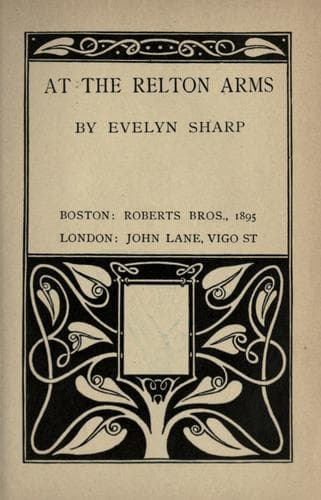
AT THE RELTON ARMS
BY EVELYN SHARP
BOSTON: ROBERTS BROS., 1895
LONDON: JOHN LANE, VIGO ST.
_Copyright_, 1895,
BY ROBERTS BROTHERS.
University Press.
JOHN WILSON AND SON, CAMBRIDGE U. S. A.
AT THE RELTON ARMS.
CHAPTER I.
It was towards the end of a crowded reception in the musician's studio.
Most of the people who had come from a sense of social obligation, and
they were chiefly the mothers of his fashionable pupils, had left when
the musician began to play his own compositions; and those who remained
behind, and occupied the position of the Greek chorus with regard to his
remarks, were his own chosen disciples, who were of course privileged to
stay much longer than ordinary acquaintances. The musician, perhaps, had
no effectual means of suggesting their departure; but neither was their
homage, being very womanly and obvious, unpleasing to him; and when the
well-dressed Philistines had driven away in their carriages, he
abandoned the attitude of the debonair host and took up that of the
prophet instead, which at once gave a serious turn to the conversation.
He then propounded his own theories, or somebody else's, at great
length, and the chorus assented with a gentle murmur of approbation
whenever there was a pause. Occasionally one of the elect would ask for
some music, and the musician would single out a pupil whom he considered
qualified to interpret what he had composed; and in the applause which
invariably followed, the performer would be entirely eclipsed by the
greater importance of what she had performed.
"Isn't it a beautiful thing? Such depth," said Mrs. Reginald Routh,
moving away from the piano where she had just been singing the
musician's last song. It was an uncomfortable habit she had of always
anticipating what the other people would have said if she had only given
them time to speak; and she had acquired it from living many years with
an unmusical though wealthy husband, who only acknowledged his wife's
musical talents by sending large checks annually to the musician. On
this occasion she caught the eye of some one who had just arrived, and
repeated her remark emphatically; for the new-comer was a stranger who
had unscrupulously interrupted the last verse of her song, and was now
absorbed in prolonging the existence of a modicum of bitter tea, one
sugar-plum, and a preserved cherry.
Public-domain text, read in full here on John Shaqi.
Reviews
Reviews
No reviews yet
Be the first to share your thoughts on this work.
Join the Discussion
Join the discussion
Sign in to leave a comment or review.
Sign InorCreate an account