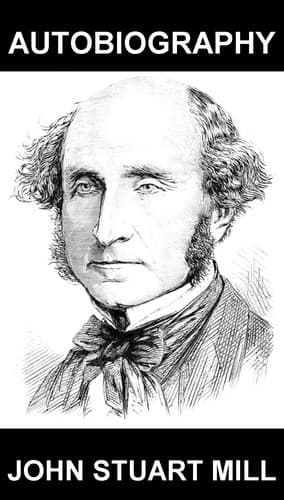
Mill, John Stuart, 1806-1873; Philosophers -- England -- Biography
From about the age of twelve, I entered into another and more advanced
stage in my course of instruction; in which the main object was no
longer the aids and appliances of thought, but the thoughts themselves.
This commenced with Logic, in which I began at once with the _Organon_,
and read it to the Analytics inclusive, but profited little by the
Posterior Analytics, which belong to a branch of speculation I was not
yet ripe for. Contemporaneously with the _Organon_, my father made me
read the whole or parts of several of the Latin treatises on the
scholastic logic; giving each day to him, in our walks, a minute account
of what I had read, and answering his numerous and most searching
questions. After this, I went in a similar manner through the _Computatio
sive Logica_ of Hobbes, a work of a much higher order of thought than the
books of the school logicians, and which he estimated very highly; in my
own opinion beyond its merits, great as these are. It was his invariable
practice, whatever studies he exacted from me, to make me as far as
possible understand and feel the utility of them: and this he deemed
peculiarly fitting in the case of the syllogistic logic, the usefulness
of which had been impugned by so many writers of authority. I well
remember how, and in what particular walk, in the neighbourhood of Bagshot
Heath (where we were on a visit to his old friend Mr. Wallace, then one
of the Mathematical Professors at Sandhurst) he first attempted by
questions to make me think on the subject, and frame some conception of
what constituted the utility of the syllogistic logic, and when I had
failed in this, to make me understand it by explanations. The
explanations did not make the matter at all clear to me at the time;
but they were not therefore useless; they remained as a nucleus for my
observations and reflections to crystallize upon; the import of his
general remarks being interpreted to me, by the particular instances
which came under my notice afterwards. My own consciousness and
experience ultimately led me to appreciate quite as highly as he did,
the value of an early practical familiarity with the school logic.
I know of nothing, in my education, to which I think myself more
indebted for whatever capacity of thinking I have attained. The first
intellectual operation in which I arrived at any proficiency, was
dissecting a bad argument, and finding in what part the fallacy lay:
and though whatever capacity of this sort I attained, was due to the
fact that it was an intellectual exercise in which I was most
perseveringly drilled by my father, yet it is also true that the
school logic, and the mental habits acquired in studying it, were
among the principal instruments of this drilling. I am persuaded that
nothing, in modern education, tends so much, when properly used, to
form exact thinkers, who attach a precise meaning to words and
propositions, and are not imposed on by vague, loose, or ambiguous
terms.
Public-domain text, read in full here on John Shaqi.
Reviews
Reviews
No reviews yet
Be the first to share your thoughts on this work.
Join the Discussion
Join the discussion
Sign in to leave a comment or review.
Sign InorCreate an account