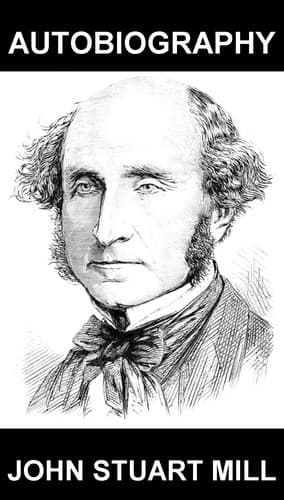
Mill, John Stuart, 1806-1873; Philosophers -- England -- Biography
The boasted influence of mathematical studies is nothing to
it; for in mathematical processes, none of the real difficulties of
correct ratiocination occur. It is also a study peculiarly adapted to
an early stage in the education of philosophical students, since it
does not presuppose the slow process of acquiring, by experience and
reflection, valuable thoughts of their own. They may become capable
of disentangling the intricacies of confused and self-contradictory
thought, before their own thinking faculties are much advanced; a
power which, for want of some such discipline, many otherwise able
men altogether lack; and when they have to answer opponents, only
endeavour, by such arguments as they can command, to support the
opposite conclusion, scarcely even attempting to confute the
reasonings of their antagonists; and, therefore, at the utmost,
leaving the question, as far as it depends on argument, a balanced one.
During this time, the Latin and Greek books which I continued to read
with my father were chiefly such as were worth studying, not for the
language merely, but also for the thoughts. This included much of the
orators, and especially Demosthenes, some of whose principal orations
I read several times over, and wrote out, by way of exercise, a full
analysis of them. My father's comments on these orations when I read
them to him were very instructive to me. He not only drew my attention
to the insight they afforded into Athenian institutions, and the
principles of legislation and government which they often illustrated,
but pointed out the skill and art of the orator--how everything
important to his purpose was said at the exact moment when he had
brought the minds of his audience into the state most fitted to
receive it; how he made steal into their minds, gradually and by
insinuation, thoughts which, if expressed in a more direct manner,
would have roused their opposition. Most of these reflections were
beyond my capacity of full comprehension at the time; but they left
seed behind, which germinated in due season. At this time I also read
the whole of Tacitus, Juvenal, and Quintilian. The latter, owing to
his obscure style and to the scholastic details of which many parts
of his treatise are made up, is little read, and seldom sufficiently
appreciated. His book is a kind of encyclopaedia of the thoughts of
the ancients on the whole field of education and culture; and I have
retained through life many valuable ideas which I can distinctly trace
to my reading of him, even at that early age. It was at this period
that I read, for the first time, some of the most important dialogues
of Plato, in particular the _Gorgias_, the _Protagoras_, and the
_Republic_. There is no author to whom my father thought himself more
indebted for his own mental culture, than Plato, or whom he more
frequently recommended to young students. I can bear similar testimony
in regard to myself. The Socratic method, of which the Platonic
Public-domain text, read in full here on John Shaqi.
Reviews
Reviews
No reviews yet
Be the first to share your thoughts on this work.
Join the Discussion
Join the discussion
Sign in to leave a comment or review.
Sign InorCreate an account