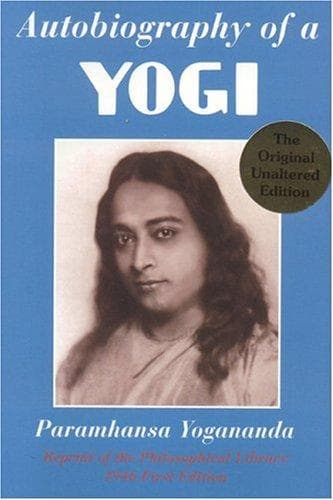
Yogananda, Paramahansa, 1893-1952; Yogis -- India -- Biography
Sadasiva complied; the boy immediately found himself among the
distant city throng. But alas! where was the saint when the youth
wanted to leave? The weary boy reached his home by the ancient and
prosaic method of foot locomotion.
{FN41-1} Miss Bletch, unable to maintain the active pace set by Mr.
Wright and myself, remained happily with my relatives in Calcutta.
{FN41-2} This dam, a huge hydro-electric installation, lights Mysore
City and gives power to factories for silks, soaps, and sandalwood
oil. The sandalwood souvenirs from Mysore possess a delightful
fragrance which time does not exhaust; a slight pinprick revives
the odor. Mysore boasts some of the largest pioneer industrial
undertakings in India, including the Kolar Gold Mines, the Mysore
Sugar Factory, the huge iron and steel works at Bhadravati, and
the cheap and efficient Mysore State Railway which covers many of
the state’s 30,000 square miles.
The Maharaja and Yuvaraja who were my hosts in Mysore in 1935 have
both recently died. The son of the Yuvaraja, the present Maharaja,
is an enterprising ruler, and has added to Mysore’s industries a
large airplane factory.
{FN41-3} Six volumes on ANCIENT INDIA (Calcutta, 1879).
{FN41-5} Neither Alexander nor any of his generals ever crossed
the Ganges. Finding determined resistance in the northwest, the
Macedonian army refused to penetrate farther; Alexander was forced
to leave India and seek his conquests in Persia.
{FN41-5} From this question we may surmise that the “Son of Zeus”
had an occasional doubt that he had already attained perfection.
{FN41-6} All Greek observers comment on the lack of slavery in
India, a feature at complete variance with the structure of Hellenic
society.
{FN41-7} CREATIVE INDIA by Prof. Benoy Kumar Sarkar gives a
comprehensive picture of India’s ancient and modern achievements
and distinctive values in economics, political science, literature,
art, and social philosophy. (Lahore: Motilal Banarsi Dass, Publishers,
1937, 714 pp., $5.00.)
Another recommended volume is INDIAN CULTURE THROUGH THE AGES, by
S. V. Venatesvara (New York: Longmans, Green & Co., $5.00).
{FN41-8} Manu is the universal lawgiver; not alone for Hindu society,
but for the world. All systems of wise social regulations and even
justice are patterned after Manu. Nietzsche has paid the following
tribute: “I know of no book in which so many delicate and kindly
things are said to woman as in the LAWBOOK OF MANU; those old
graybeards and saints have a manner of being gallant to women which
perhaps cannot be surpassed . . . an incomparably intellectual and
superior work . . . replete with noble values, it is filled with a
feeling of perfection, with a saying of yea to life, and a triumphant
sense of well-being in regard to itself and to life; the sun shines
upon the whole book.”
Public-domain text, read in full here on John Shaqi.
Reviews
Reviews
No reviews yet
Be the first to share your thoughts on this work.
Elsewhere in the archive
Join the Discussion
Join the discussion
Sign in to leave a comment or review.
Sign InorCreate an account