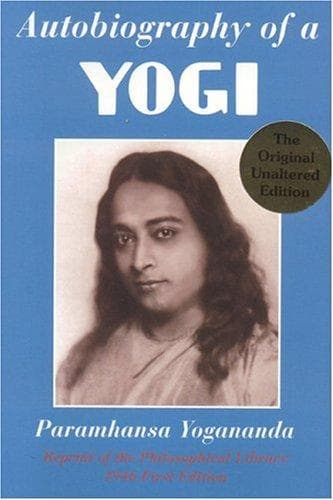
Yogananda, Paramahansa, 1893-1952; Yogis -- India -- Biography
“‘From my birth, sir! Never have my eyes been blessed with a glimpse
of the sun.’
“‘Our omnipotent guru can help you. Please make a supplication.’
“The following day Ramu diffidently approached Lahiri Mahasaya. The
disciple felt almost ashamed to ask that physical wealth be added
to his spiritual superabundance.
“‘Master, the Illuminator of the cosmos is in you. I pray you
to bring His light into my eyes, that I perceive the sun’s lesser
glow.’
“‘Ramu, someone has connived to put me in a difficult position. I
have no healing power.’
“‘Sir, the Infinite One within you can certainly heal.’
“‘That is indeed different, Ramu. God’s limit is nowhere! He who
ignites the stars and the cells of flesh with mysterious life-effulgence
can surely bring luster of vision into your eyes.’
“The master touched Ramu’s forehead at the point between the eyebrows.
{FN4-7} “‘Keep your mind concentrated there, and frequently chant
the name of the prophet Rama {FN4-8} for seven days. The splendor
of the sun shall have a special dawn for you.’
“Lo! in one week it was so. For the first time, Ramu beheld the
fair face of nature. The Omniscient One had unerringly directed his
disciple to repeat the name of Rama, adored by him above all other
saints. Ramu’s faith was the devotionally ploughed soil in which
the guru’s powerful seed of permanent healing sprouted.” Kebalananda
was silent for a moment, then paid a further tribute to his guru.
“It was evident in all miracles performed by Lahiri Mahasaya that
he never allowed the ego-principle {FN4-9} to consider itself a
causative force. By perfection of resistless surrender, the master
enabled the Prime Healing Power to flow freely through him.
“The numerous bodies which were spectacularly healed through Lahiri
Mahasaya eventually had to feed the flames of cremation. But the
silent spiritual awakenings he effected, the Christlike disciples
he fashioned, are his imperishable miracles.”
I never became a Sanskrit scholar; Kebalananda taught me a diviner
syntax.
{FN4-1} Literally, “renunciate.” From Sanskrit verb roots, “to cast
aside.”
{FN4-2} Effects of past actions, in this or a former life; from
Sanskrit KRI, “to do.”
{FN4-3} BHAGAVAD GITA, IX, 30-31. Krishna was the greatest prophet
of India; Arjuna was his foremost disciple.
{FN4-4} I always addressed him as Ananta-da. DA is a respectful
suffix which the eldest brother in an Indian family receives from
junior brothers and sisters.
{FN4-5} At the time of our meeting, Kebalananda had not yet joined
the Swami Order and was generally called “Shastri Mahasaya.” To avoid
confusion with the name of Lahiri Mahasaya and of Master Mahasaya
(../chapter 9), I am referring to my Sanskrit tutor only by his
later monastic name of Swami Kebalananda. His biography has been
recently published in Bengali. Born in the Khulna district of
Bengal in 1863, Kebalananda gave up his body in Benares at the age
of sixty-eight. His family name was Ashutosh Chatterji.
Public-domain text, read in full here on John Shaqi.
Reviews
Reviews
No reviews yet
Be the first to share your thoughts on this work.
Join the Discussion
Join the discussion
Sign in to leave a comment or review.
Sign InorCreate an account