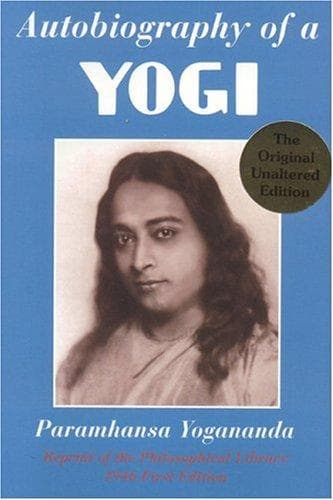
Yogananda, Paramahansa, 1893-1952; Yogis -- India -- Biography
{FN4-6} The ancient four VEDAS comprise over 100 extant canonical
books. Emerson paid the following tribute in his JOURNAL to Vedic
thought: “It is sublime as heat and night and a breathless ocean.
It contains every religious sentiment, all the grand ethics which
visit in turn each noble poetic mind. . . . It is of no use to put
away the book; if I trust myself in the woods or in a boat upon the
pond, Nature makes a BRAHMIN of me presently: eternal necessity,
eternal compensation, unfathomable power, unbroken silence. . . .
This is her creed. Peace, she saith to me, and purity and absolute
abandonment—these panaceas expiate all sin and bring you to the
beatitude of the Eight Gods.”
{FN4-7} The seat of the “single” or spiritual eye. At death the
consciousness of man is usually drawn to this holy spot, accounting
for the upraised eyes found in the dead.
{FN4-8} The central sacred figure of the Sanskrit epic, RAMAYANA.
{FN4-9} Ahankara, egoism; literally, “I do.” The root cause of
dualism or illusion of MAYA, whereby the subject (ego) appears as
object; the creatures imagine themselves to be creators.
CHAPTER: 5
A “PERFUME SAINT” DISPLAYS HIS WONDERS
“To every thing there is a season, and a time to every purpose
under the heaven.”
I did not have this wisdom of Solomon to comfort me; I gazed
searchingly about me, on any excursion from home, for the face of
my destined guru. But my path did not cross his own until after
the completion of my high school studies.
Two years elapsed between my flight with Amar toward the Himalayas,
and the great day of Sri Yukteswar’s arrival into my life. During
that interim I met a number of sages-the “Perfume Saint,” the “Tiger
Swami,” Nagendra Nath Bhaduri, Master Mahasaya, and the famous
Bengali scientist, Jagadis Chandra Bose.
My encounter with the “Perfume Saint” had two preambles, one
harmonious and the other humorous.
“God is simple. Everything else is complex. Do not seek absolute
values in the relative world of nature.”
These philosophical finalities gently entered my ear as I stood
silently before a temple image of Kali. Turning, I confronted a
tall man whose garb, or lack of it, revealed him a wandering SADHU.
“You have indeed penetrated the bewilderment of my thoughts!” I
smiled gratefully. “The confusion of benign and terrible aspects
in nature, as symbolized by Kali, {FN5-1} has puzzled wiser heads
than mine!”
“Few there be who solve her mystery! Good and evil is the challenging
riddle which life places sphinxlike before every intelligence.
Attempting no solution, most men pay forfeit with their lives,
penalty now even as in the days of Thebes. Here and there, a towering
lonely figure never cries defeat. From the MAYA {FN5-2} of duality
he plucks the cleaveless truth of unity.”
“You speak with conviction, sir.”
Public-domain text, read in full here on John Shaqi.
Reviews
Reviews
No reviews yet
Be the first to share your thoughts on this work.
Join the Discussion
Join the discussion
Sign in to leave a comment or review.
Sign InorCreate an account