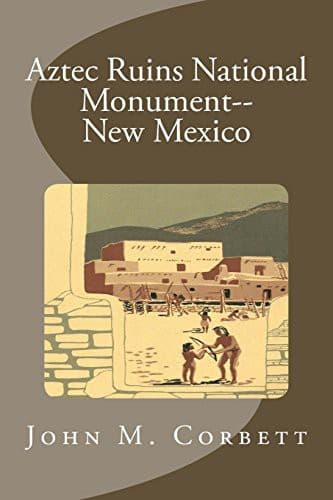
Aztec Ruins National Monument, New MexicoCorbett, John M. (John Maxwell)
History
Aztec Ruins National Monument, New Mexico
Corbett, John M. (John Maxwell)
Aztec Ruins National Monument (N.M.)
Cotton was probably introduced at about the beginning of the Pueblo
period, along with loom weaving. This allowed the making of true cloth,
suitable for blankets, poncho-like shirts, sashes, wrap-around skirts,
and other necessary items. One other important change at this time
affected physical appearance. The soft cradle of the Basketmakers was
replaced by the hard cradleboard of the Pueblos. Since the infant
usually was bound securely upon his back in the cradle and was unable to
roll around, the pressure of the hard board, instead of the softer
cradle, caused the back of its head to become flattened, thus giving the
whole head a much broader and rounder appearance. This skull flattening
in no way affected the mentality of the child, but it must have been
obvious to the parents what was causing it. Through continued use of the
cradleboard, skull flattening must quickly have become a mark of
distinction and charm and, in a few generations, it must have become the
traditional head shape of the Pueblo Indians.
Dogs and turkeys were still the only domesticated animals, the turkeys
probably kept as much for their feathers (and thus periodically plucked)
as for their food value. Burials of both dogs and turkeys occur,
indicating they were evidently regarded as more than mere food. Bones
from the refuse piles indicate the people hunted—or acquired by
trade—bear, elk, bison, wolf, mountain sheep, deer, and rabbits.
There was no sharp break between this period and the preceding
Basketmaker. The Indians themselves did not know when they left one
period and embarked upon the next. Actually, such “periods” are the
classification devices of the archeologists, who need names to apply to
the times at which different cultural and evolutionary changes occur. In
retrospect, the archeologist can see certain important changes which
began to take place about A.D. 750. Liking to classify and categorize
the remains they study, archeologists first divided this broad Pueblo
period into five substages labeled Pueblo I, II, III, IV, and V. Later,
the first two substages were grouped together as the Developmental
Pueblo Period, the third was called the Great Pueblo Period, the fourth
became known as the Regressive Pueblo Period, and the last as the
Historic Pueblo Period. These terms are more meaningful and will be used
hereafter. The last two do not concern us, for at the end of the Great
Pueblo Period, seemingly at the time of the well-known drought (A.D.
1276-99), most of the pueblo-dwelling peoples left the San Juan area,
never to return.
Public-domain text, read in full here on John Shaqi.
Reviews
Reviews
No reviews yet
Be the first to share your thoughts on this work.
Join the Discussion
Join the discussion
Sign in to leave a comment or review.
Sign InorCreate an account