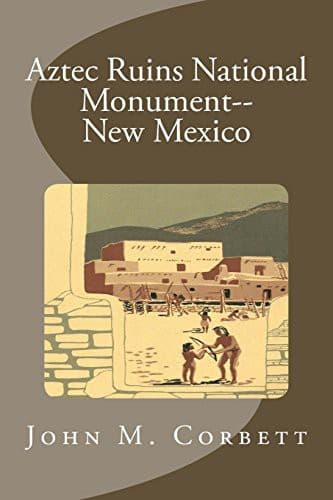
Aztec Ruins National Monument, New MexicoCorbett, John M. (John Maxwell)
History
Aztec Ruins National Monument, New Mexico
Corbett, John M. (John Maxwell)
Aztec Ruins National Monument (N.M.)
Archeologists have dug up some unusual burials from this period. One was
a male who, presumably after death, had been cut in two at the waist and
then sewed together again. Why this was done, nobody knows. He was also
wearing a pair of leather moccasins, an item not often found among the
Basketmakers. Another burial, from the Canyon del Muerto in northeastern
Arizona, consisted of only a pair of forearms and hands, lying palms up,
side by side on a bed of grass. Wrapped around the wrists were three
necklaces with abalone shell pendants. Ironically enough, included in
the grave offerings were two pairs of the finest sandals ever found.
Over the whole lay a large basket about 2 feet in diameter. Conjectures
as to the “whys” and “whats” of this burial have been numerous, but
probably the true reason will never be known.
THE PUEBLOS.
The second broad period in the history of the San Juan area is that in
which the Indians built communal dwellings called pueblos. These were
stone and adobe structures, sometimes multistoried, facing a central
plaza which contained one or more kivas. Very similar structures and
village plans can be seen in a number of the existing pueblos of the Rio
Grande today, notably Taos, Santo Domingo, and San Ildefonso.
Over the previous centuries the inhabitants of the San Juan Basin, and
especially the Animas Valley, had gradually developed a different way of
life from that of the early Basketmakers. Certainly, they still grew
corn, beans, and squash; still hunted and snared game; still grew old,
died, and were buried. But in addition to having some of the better
material things in life such as pottery and the bow and arrow, they now
placed a greater emphasis upon agriculture; hunting and seed gathering
were secondary sources of food. In the spring, the corn seeds were
carefully planted, watched over, watered, and cared for. As the plants
matured, the men and young boys spent more time in the fields. During
the day it was necessary to drive off the squirrels and birds; at night
the green tender plants must be protected from the deer, rabbits, and
nocturnal rodents. Water in this semiarid land had to be carefully
managed, whether flood irrigation or planned canal irrigation was used.
If all these factors were not judiciously controlled, there would be no
crop. The forces of nature seemed increasingly important; too much sun
could be as disastrous as too much water. Ceremonies were devised to
propitiate the spirits and the gods, who, to the Indians resided in all
aspects of nature. More time was devoted to seasonal religious
activities, and great care was taken to educate the young in the proper
performance of the ceremonies so they, too, might continue to prosper
and live in harmony with nature.
Public-domain text, read in full here on John Shaqi.
Reviews
Reviews
No reviews yet
Be the first to share your thoughts on this work.
Join the Discussion
Join the discussion
Sign in to leave a comment or review.
Sign InorCreate an account