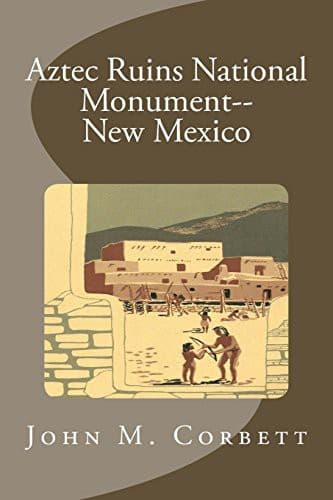
Aztec Ruins National Monument, New Mexico — John Shaqi
Aztec Ruins National Monument, New MexicoCorbett, John M. (John Maxwell)
History
Aztec Ruins National Monument, New Mexico
Corbett, John M. (John Maxwell)
Aztec Ruins National Monument (N.M.)
The San Juan River and its tributaries drain the region known as the
Four Corners country—the area surrounding the point where New Mexico,
Colorado, Utah, and Arizona meet in a common boundary at right angles.
Rising high in the Rocky Mountains of Colorado, the San Juan flows
southwestward to dip down into the northwestern corner of New Mexico;
then it courses northwestward into Utah almost at the point of juncture
of the four states. With many twists and curves, roaring through deep
canyons and gulches, it proceeds generally westward to empty into the
mighty Colorado River in the southeastern part of Utah.
The San Juan Basin is the major drainage basin of the Four Corners
country. As such, its lower reaches formed a formidable barrier to
travel by migrant primitive groups and to early white settlers as well.
Its upper portions, however, especially its tributaries, were easier of
access and supplied that most important element of all for life in the
desert: water—water for drinking, water for irrigation.
The land between the tributaries is highly diversified; much is arid or
semiarid with small streams running intermittently or with scattered
springs that may be dry during parts of the year. Other areas are
mountainous with swift-flowing streams. In places there are mesas, or
large tablelands, which frequently are covered with forests of pine,
juniper, and pinyon. It is a land of warm, often hot, summers and cool,
sometimes very cold, winters; a land of sharp contrasts; a land that
seems perpetual, yet never appears exactly the same on any two
successive days.
Into this area many hundreds of years ago, possibly even thousands, came
small bands of wandering hunters. Gradually some of them learned how to
adapt to the rigors of the land. Eventually two centers arose in which
the local inhabitants successfully adjusted to their environment: one
along the Chaco Wash in northwestern New Mexico, and the second in
southwestern Colorado in many places on the La Plata, Mancos, and McElmo
drainages. Chaco, the first of these cultural manifestations, takes its
name from the best known and finest examples of such ruins in Chaco
Canyon National Monument. The other is best known at, and named for, the
area incorporated in Mesa Verde National Park.
[Illustration: ]
On the northern side of the San Juan, most of its tributaries are
perennially flowing streams and rivers, with broad, fertile valleys and
bountiful plant and animal resources nearby. On one of these streams,
the Animas, there existed a series of prehistoric towns and villages
which exemplify the successful blending of cultural influences from both
the major centers of Chaco and Mesa Verde. This is the general story of
the San Juan River area, of the people who lived there long ago, and in
particular the story of the great ruined pueblo on the Animas River near
the present-day town of Aztec, N. Mex.
EARLY HUNTERS AND GATHERERS.
Public-domain text, read in full here on John Shaqi.
Reviews
Reviews
No reviews yet
Be the first to share your thoughts on this work.
Join the Discussion
Join the discussion
Sign in to leave a comment or review.
Sign InorCreate an account