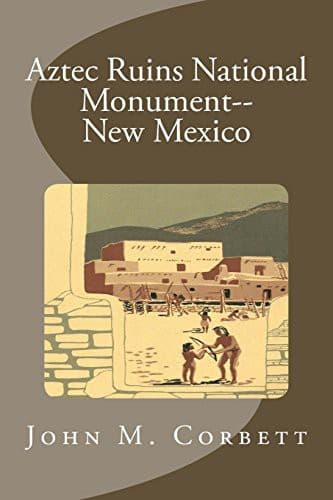
Aztec Ruins National Monument, New MexicoCorbett, John M. (John Maxwell)
History
Aztec Ruins National Monument, New Mexico
Corbett, John M. (John Maxwell)
Aztec Ruins National Monument (N.M.)
To the northwest of the ruins, less than 2 miles away, the Indians found
an outcropping of sandstone which could be broken into shape and then
ground into rectangular blocks. These were hauled to the proposed
building site, where the women took over the construction. Holes were
dug in the clay soil nearby, water poured into them, and then stirred to
produce a thick adobe mud. This was used, along with crude unshaped
sandstone blocks, as filler for the walls. On the outside, the women
laid up the well-shaped blocks in regular courses, chinking them with
small spalls or potsherds.
The rooms were laid out in rows adjoining one another; as one row was
finished, another was added alongside of it. When several rows had been
completed, second and possibly even third stories were added. The first
group to arrive probably completed the major part of one wing; later
groups added to this and erected the other wings and associated kivas
until the entire pueblo had the traditional planned aspect of a typical
plaza-enclosed Chaco pueblo. In the central plaza area several kivas
were dug and roofed over at ground level. The fourth side consisted of a
single row of one-storied rooms. Finally, even a fourth story may have
been added in places. Sometimes a large square space was temporarily
left open, later to be filled by a circular kiva.
Out in the plaza, during the latter part of this first occupation, work
started on the Great Kiva, for this was the center of the ceremonial
life of the entire pueblo. Here would be performed the ceremonies which
would insure the inhabitants that theirs would be a long and happy life
and that everything would prosper for the new community.
For roofing the rooms, main stringers of pine or juniper were used, and
over these were laid splits of juniper or long poles of cottonwood. Next
came a layer of rush or reed mattings and then a layer of dirt and adobe
which formed the top of the roof, or the floor of the room above if
there was more than one story.
The pine logs used for the main stringers are good-sized, many being 1
foot to 1½ feet in diameter and up to 10 or 12 feet long. Although
juniper is still fairly abundant in the nearby country, good stands of
pine today are many miles away. At the time the first parts of this
pueblo were constructed, the pine forest may have been much closer.
Perhaps extensive cutting hastened soil erosion and thus caused the
forest growth to retreat.
Prehistorically it still was a long haul to bring in such big logs. Many
people have assumed that the logs were floated down the Animas River.
This would have been the easy way of doing it, but the logs found _in
situ_ in the ruins were obviously fresh cut, peeled while green, and
show no scars. They must therefore have been carried overland from their
source, no matter how far away, for it would have been impossible to
float them downstream without being scarred and bruised in transit.
Public-domain text, read in full here on John Shaqi.
Reviews
Reviews
No reviews yet
Be the first to share your thoughts on this work.
Join the Discussion
Join the discussion
Sign in to leave a comment or review.
Sign InorCreate an account