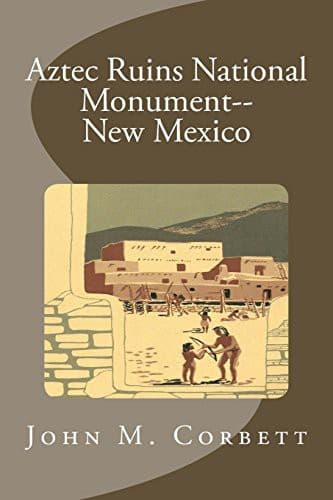
Aztec Ruins National Monument, New Mexico — John Shaqi
Aztec Ruins National Monument, New MexicoCorbett, John M. (John Maxwell)
History
Aztec Ruins National Monument, New Mexico
Corbett, John M. (John Maxwell)
Aztec Ruins National Monument (N.M.)
In each of the two areas mentioned above—Chaco Canyon and Mesa
Verde—archeological work has revealed a continuous occupation of the
sites and the immediate vicinity. At the great Aztec ruin, however,
there is still some doubt as to what really happened. In two different
time periods there seem to be strong architectural relations to both the
Chaco and Mesa Verde centers, as well as close ties in ceramics and
other items of material culture. Part of the intriguing mystery at Aztec
is whether these similarities represent actual migrations from those
centers on a fairly large scale, or an exchange of ideas, or small
groups of migrants who strongly influenced the local population.
In the midst of the populous Animas Valley, along the edge of an old
river terrace, early in the 1100’s a large multistoried stone pueblo was
built in an architectural style reminiscent of that in Chaco Canyon. Did
a large migrant group from the Chaco area—or some other area where
Chaco-like people were living—move into the Animas Valley and erect this
structure? Or did some of the local citizenry decide to join in a
community effort and copy the building techniques of their neighbors to
the south? If so, what was the impetus which launched the local people
upon this ambitious project? Perhaps a small group of highly skilled
technicians, under the leadership of a few “priests” or medicine men,
came from the Chaco area into the Animas Valley. Once established there,
by persuasion, teachings, or by religious magic and psychological
control, they may have prevailed upon some of the local population to
join them and to build their homes and kivas of sandstone blocks, in the
traditional Chaco style.
We may never know the exact answer to these questions, but wherever the
people came from, whoever they may have been, whatever the guiding
impetus, Aztec pueblo, like Rome, was not built in a day. Dates from
tree rings—as described later—indicate that the pueblo was built between
A.D. 1110-1124, with the major construction periods in 1111 and 1115.
Probably a small group, or just a clan, moved into the site about 1110,
and finding it suitable for habitation erected the first small part of
the pueblo. The next year a much larger group, perhaps several clans or
more, joined the earlier settlers and more than 50 percent of the pueblo
was finished. Then, in 1114 or 1115, a third wave of migrants arrived
and essentially completed the pueblo, except for the one-story row of
rooms which closed off the south side. It is possible that some of the
indigenous Animas population joined these newcomers and moved in with
them. From 1115 until about 1124 or 1125, occasional rooms were added as
new quarters were necessary for newly married couples and as old rooms
were used as refuse dumps.
Public-domain text, read in full here on John Shaqi.
Reviews
Reviews
No reviews yet
Be the first to share your thoughts on this work.
Join the Discussion
Join the discussion
Sign in to leave a comment or review.
Sign InorCreate an account