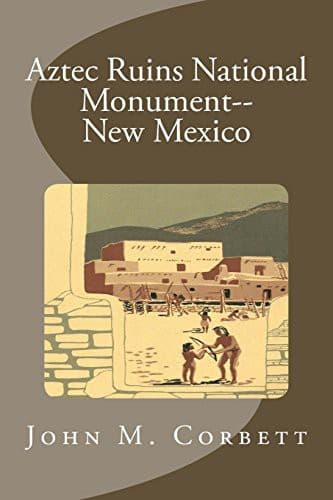
Aztec Ruins National Monument, New Mexico — John Shaqi
Aztec Ruins National Monument, New MexicoCorbett, John M. (John Maxwell)
History
Aztec Ruins National Monument, New Mexico
Corbett, John M. (John Maxwell)
Aztec Ruins National Monument (N.M.)
In fact, it could better be proposed that some of the first groups,
which had to leave Chaco Canyon about 1100 because of the incipient
arroyo and its accompanying loss of irrigation water and generally
lowering water table, might actually have moved to the Animas and
established Aztec. Perhaps a rather coincidental event may have occurred
at Aztec which caused its abandonment just as Chaco Canyon was almost
depopulated. The early settlers in the Animas recall evidence of a
prehistoric canal flowing along the lower slopes of the terrace to the
north of Aztec Ruins, somewhat lower than the modern one. This canal
took off on the right bank of the river, several miles upstream from the
pueblo. A major shifting of the river, a swing of the main stream
against this old river terrace on the right bank, would have effectively
cut the canal at a point below which the people could not take off water
to irrigate their fields and in a manner they could not repair. Such a
disaster would have forced them to move to other cultivable fields; if
none were available nearby (and they may have all been taken up by other
local groups), they would have had to go far away. They couldn’t return
to Chaco Canyon or other areas near there, for these places too were
being depopulated. So perhaps they followed some of their Chaco kinfolk
who were intermittently migrating in groups to the Rio Grande, or to the
Hopi country. In these new areas, mixing with the local population, they
lost their distinct cultural identity. We can look at the modern Pueblo
Indians of today and wonder if perhaps some of their long ago ancestors
may not have actually lived at Aztec or in Chaco Canyon.
[Illustration: A pottery “kiva” jar. Mesa Verde style. Diameter at
mouth, 4½″; Maximum diameter, 13⅓″; Height, 9½″.]
But there is a double mystery at Aztec: as indicated earlier, overlying
the evidences of a Chaco-phase occupation, Morris found evidence of
rebuilding and rehabitation of many rooms. Large-sized Chaco rooms had
been shortened, reduced, or cut off by interior walls and lowered
ceilings. Older doorways had been blocked up, or had been partially
filled and reduced in size. In some cases entire small rooms, complete
with ceilings, had been built within larger rooms. New floors had been
laid down upon the debris and windblown sand which partially filled some
of the older rooms. Older beams had been pulled out of rooms and reused
elsewhere, or new walls in a different style had been built in place of
those that had collapsed.
Public-domain text, read in full here on John Shaqi.
Reviews
Reviews
No reviews yet
Be the first to share your thoughts on this work.
Join the Discussion
Join the discussion
Sign in to leave a comment or review.
Sign InorCreate an account