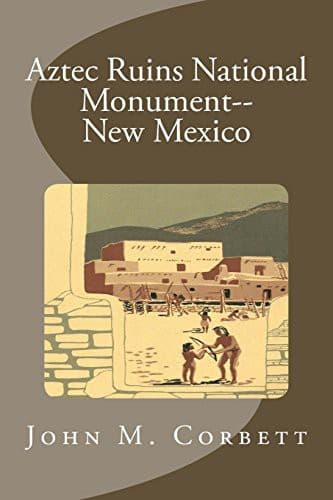
Aztec Ruins National Monument, New MexicoCorbett, John M. (John Maxwell)
History
Aztec Ruins National Monument, New Mexico
Corbett, John M. (John Maxwell)
Aztec Ruins National Monument (N.M.)
In contrast to the Chacoan occupation, Morris found a large number of
burials (149) from this period, mostly in the rooms. Many were buried
with great care and had numerous and varied grave offerings. For a
while, evidently, the Pueblos prospered and traded far and wide for
luxury items. But once again bad times set in, possibly accompanied by
almost constant armed harassment by less fortunate groups. Although
Morris did not find any direct evidence that the people at Aztec were
actually killed off or driven out by armed conflict, the later burials
were all hastily made and usually unaccompanied by grave offerings. In
addition, almost the entire east wing had been destroyed by fire. This
could have been accidental and such a disaster might have proven the
final straw for an already beleaguered group; or they may have fired the
pueblo before leaving, or some marauding group might have been
responsible.
[Illustration: An Aztec Ruins burial with pottery mug in situ.]
Exactly why, after 25 or 30 years, the second group also abandoned the
site we may never know. Times were hard in the Four Corners country, and
by 1300 this area seems to have been virtually depopulated. Perhaps the
abandonment of Aztec, sometime after 1252, was simply a local
manifestation of this much larger dispersal.
No doubt the great drought of the last quarter of that century
contributed substantially to this general abandonment, but there must
have been other factors at work as well. The Indians regard the forces
of nature in a different manner than we do. They may have been
struggling through long years, not only with nature but among
themselves. They may have felt that their gods were against them, that
somehow they had offended them, and that nothing they could do in that
country would be right again. It may have seemed easier to them, family
by family, group by group, and perhaps pueblo by pueblo, to give up the
struggle and go elsewhere, to start over in new surroundings where the
gods might smile upon them once again.
_Explorations and Excavations_
Despite popular opinion, and despite the name applied to the ruins, the
Indians who built this ancient pueblo were not related to the warlike
Aztecs of Mexico. In the late 1800’s, there was considerable interest in
the seemingly mysterious Aztec, Toltecs, and other Indians of Mexico.
The writings of Stephens, Prescott and others had fired imaginations,
and new communities—particularly those in the vicinity of Indian
ruins—were often given names of Indian groups from south of the border.
So it was with the town of Aztec. When white settlers first moved into
the Animas Valley, they were intrigued by the great stone ruins.
Believing them to be the work of a long-vanished race from the south,
they named their town Aztec.
Public-domain text, read in full here on John Shaqi.
Reviews
Reviews
No reviews yet
Be the first to share your thoughts on this work.
Join the Discussion
Join the discussion
Sign in to leave a comment or review.
Sign InorCreate an account