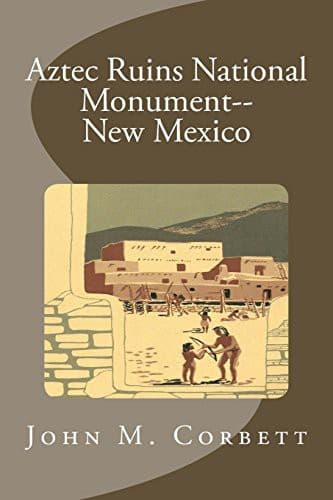
Aztec Ruins National Monument, New MexicoCorbett, John M. (John Maxwell)
History
Aztec Ruins National Monument, New Mexico
Corbett, John M. (John Maxwell)
Aztec Ruins National Monument (N.M.)
The second occupation at Aztec was more intensive and one in which parts
of the local population participated actively. The construction style of
this period shows a considerable use of local cobblestones set in adobe
mortar, as in many of the small ruins throughout the Animas. Sometimes
cobblestone walls are overlaid or underlaid by, or even intermingled
with, sandstone walls. It was at this time also, as far as we know, that
the other pueblo units—now all ruins—within the monument boundary were
constructed, as well as several other major Mesa Verde-phase structures
elsewhere in the Animas Valley.
In addition, large quantities of new material had to be secured fairly
rapidly to keep pace with the feverish building activities at Aztec.
While some of the rooms of the large Chaco-style pueblo were
rehabilitated by these new inhabitants, others were dismantled and their
materials, in addition to those from fallen walls, were used elsewhere.
But even this great pueblo could not supply all the stone needed. So
from the old quarry to the site of the pueblo two paths were built, side
by side, each wide enough for eight men to walk abreast. For many
months, men with stone mauls and hammers cracked and chopped and ground
the sandstone into building blocks. Other men and the stronger boys
toiled all day in straggling lines, carrying the blocks on large wooden
litters or in great slings strung on poles. Long lines of workers
streamed down one path, loaded with blocks, to return over the other
path with their empty litters and slings.
Although the Great Kiva was repaired, with rather sloppy workmanship in
many places, it was probably only used for a brief period. The focal
point of the community’s religious life seems to have centered around
the peculiar and somewhat puzzling tri-wall structures, two of which
exist at Aztec. One is the excavated Hubbard Mound site just to the
northwest of the main ruin; the other is Mound F, which is also to the
northwest of the other major but largely unexcavated ruin—the East Ruin.
If there was such a thing at this time as the beginning of a priestly
hierarchy among the Pueblo peoples, these tri-wall structures with their
centralized kivas may have been the domiciles and religious quarters of
this hierarchy.
Once again life seemed to flourish at Aztec. This time, with all the
extra pueblo units close to each other, the area must have resembled a
veritable beehive. It would have taken an extensive farming area to
support the population. If a shift in the river had cut the Chacoans’
canal, another shift back again may have made it possible to restore the
old canal, improve it, and once again make the surrounding fields green
in summer with growing corn, beans, squash, and cotton.
Public-domain text, read in full here on John Shaqi.
Reviews
Reviews
No reviews yet
Be the first to share your thoughts on this work.
Join the Discussion
Join the discussion
Sign in to leave a comment or review.
Sign InorCreate an account