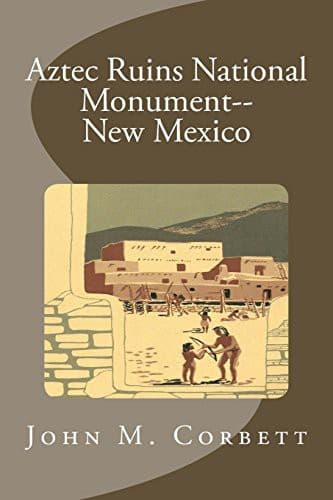
Aztec Ruins National Monument, New MexicoCorbett, John M. (John Maxwell)
History
Aztec Ruins National Monument, New Mexico
Corbett, John M. (John Maxwell)
Aztec Ruins National Monument (N.M.)
Having spent the winter of 1915 in New York City at Columbia University,
Morris was well acquainted with the leading archeologists at the
American Museum of Natural History. It was, therefore, upon Dr. Nelson’s
recommendation that the ruins at Aztec would make an excellent subject
for intensive study by the museum, that Morris was hired to conduct the
investigations. He was in charge of the Aztec excavations from 1916-21,
and sporadically through 1923, at which time the area became a National
Monument. Morris was the first custodian, as they were called in those
days, and was officially appointed on February 8, 1923, at the salary of
$12 per annum.
He not only excavated the major part of the West Ruin very carefully,
but also stabilized and repaired the walls as he went along, for the
museum greatly desired that this ruin might be preserved as an
outstanding monument. Later, in 1933-34, Morris’ services were loaned to
the National Park Service by the Carnegie Institution so that he might
accurately restore and reroof the Great Kiva at Aztec.
Morris dug in a number of other places throughout the Southwest in
addition to Aztec and therefore was in a better position than any other
man of his time to interpret and explain the development of the
prehistoric cultures in the Four Corners country. He produced a number
of valuable archeological reports, most of them under the auspices of
the Carnegie Institution for which he worked for many years. With his
death in 1956, Southwestern archeology suffered a severe loss, for there
are not many scientific investigators with both his skill and
motivation. As his lifelong friend A. V. Kidder has said about him:
Throughout his career, Morris was doubly motivated. First, of course,
by the urge to trace the course and discern the causes of historical
events and cultural developments. Secondly, by an exceptionally ardent
wish to make evident to the world of today the achievements of the
past. Back of this was his own admiration for and striving to preserve
all ancient things that were beautifully and soundly made. I think he
may also have felt, perhaps subconsciously, an obligation to repay, by
rescuing their work from oblivion, the men and women of long ago whose
artistry and manual skills gave him such keen and lasting pleasure.
[Illustration: Mesa Verde-style pottery mugs. Left mug: Diameter at
bulge, 4⅓″; Diameter at mouth, 3″; Height, 4¼″. Right mug: Diameter at
bulge, 4⅓″; Diameter at mouth, 3″; Height, 4¼″.]
Public-domain text, read in full here on John Shaqi.
Reviews
Reviews
No reviews yet
Be the first to share your thoughts on this work.
Join the Discussion
Join the discussion
Sign in to leave a comment or review.
Sign InorCreate an account