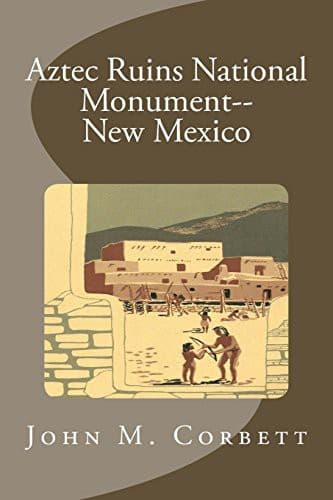
Aztec Ruins National Monument, New MexicoCorbett, John M. (John Maxwell)
History
Aztec Ruins National Monument, New Mexico
Corbett, John M. (John Maxwell)
Aztec Ruins National Monument (N.M.)
Digging in ruins such as at Aztec, where a dry climate has helped
preserve many perishable items normally lost to archeologists and where
there was always the opportunity of suddenly discovering a fairly
complete and undisturbed room, must have been a stimulating experience
to a man of Morris’ capabilities. One has only to browse through his
reports and articles, or to glance at the pictures therein, to get the
feeling of intense excitement about each discovery that prevailed
throughout the 5 years he was digging there. It would be impossible to
describe everything that Morris excavated, but several of the burials
that he uncovered were of exceptional interest.
[Illustration: Pottery ladles from Aztec Ruins. Left ladle: Diameter of
bowl, 4¼″; Handle length, 12½″; Height, 2¼″. Right ladle: Diameter of
bowl, 5″; Handle length, 6¾″; Height, 2½″.]
One consists of what may be the only known case of prehistoric Pueblo
surgery. In one of the rooms Morris found the remains of a young female
17 to 20 years of age accompanied by several bowls and a pottery mug.
The body had been wrapped in an excellently woven cotton cloth, which in
turn, had been covered by a mantle of feather cloth and finally, with a
mat of plaited rushes. The young lady had been seriously injured,
perhaps in a fall, for the hip had been severely fractured, several
vertebrae cracked, and both bones of the left forearm badly broken. But
what was of particular interest, was that an attempt had been made to
treat the broken arm. Six wooden splints, each flat on one side and
convex on the other, had been bound in longitudinal position around the
arm. As Morris said, if the Indians who attempted to help this girl
realized that her pelvis was also broken they were unable to do anything
about that, but evidently they had attempted to set the arm and return
it to normal. Unfortunately, death occurred before sufficient time had
elapsed to permit the healing to begin, so we do not know how successful
this sort of treatment might have been. Although the surgery may seem
crude and bungling to us, at least it shows an awareness of what was
wrong and an attempt to correct it.
[Illustration: Full-grooved ax with fragment of hafting material.
Length, 7″; Maximum width, 3½″; Width at groove, 2¾″.]
Public-domain text, read in full here on John Shaqi.
Reviews
Reviews
No reviews yet
Be the first to share your thoughts on this work.
Join the Discussion
Join the discussion
Sign in to leave a comment or review.
Sign InorCreate an account