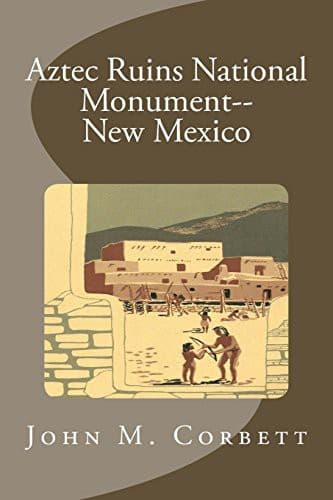
Aztec Ruins National Monument, New MexicoCorbett, John M. (John Maxwell)
History
Aztec Ruins National Monument, New Mexico
Corbett, John M. (John Maxwell)
Aztec Ruins National Monument (N.M.)
Of course, such a scene is imaginary, but it could have taken place
about 10,000 years ago, almost anywhere among the valley and canyon
bottoms of what is now known as the Four Corners country of the
Southwest. The great continental ice sheets never got this far south,
and 10,000 years ago they were already retreating northward from their
farthest expansion. Yet smaller glaciers in some of the surrounding
mountains were also shrinking, and the general climate of the area must
have been far different than it is today. No doubt it was colder and
damper, with more rain and many swamps, lagoons, and lakes abounding in
game animals and birds of all varieties. With a colder climate, the
scenery too did not resemble that of today. High grasslands, extensive
hardwood forests, and full-flowing streams and rivers characterized the
region. The general land formations, however—the mountains, canyons,
mesas, and plateaus—had been formed long millenia before, and as short a
time as 10,000 years ago they would have been very much as they are
today.
Geologists believe that after the last of the four great continental
glaciations (i.e. the Wisconsin) there were three broad climatic periods
over most of the western United States. These are called the Anathermal,
which was cool and moist, becoming gradually warmer; the Altithermal,
which was exceptionally dry; and the Medithermal, a relatively cool,
moist period which is still in progress. Our imaginary tale about the
hunters, if it had taken place, would have occurred during the
Anathermal period.
These variations in climate have been determined by studying old stream
terraces (streams cut deeper when there is more water, and they can
carry a greater load of abrasive sands and gravels); old beach levels
around ancient lakes (such as are prominent today around the Great Salt
Lake in Utah); and ancient annual lake deposits of fine silts which form
thin bands, or varves. Studies of animal life, both vertebrate and
invertebrate, and plant life are important, for some life forms can
exist only under certain limited climatic conditions. Bones and shells
found in various deposits may help to indicate the type of climate
existing when they were laid down. Plant fragments, pollen grains, and
diatoms (microscopic plants with siliceous skeletons), are clues in
telling the story of prehistoric times.
Public-domain text, read in full here on John Shaqi.
Reviews
Reviews
No reviews yet
Be the first to share your thoughts on this work.
Join the Discussion
Join the discussion
Sign in to leave a comment or review.
Sign InorCreate an account