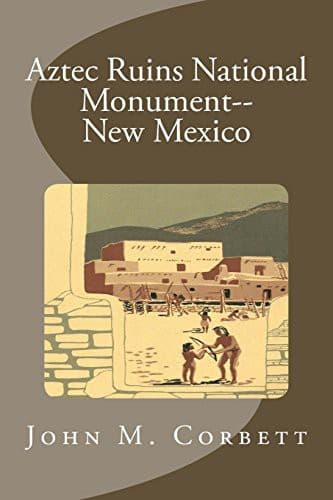
Aztec Ruins National Monument, New Mexico — John Shaqi
Aztec Ruins National Monument, New MexicoCorbett, John M. (John Maxwell)
History
Aztec Ruins National Monument, New Mexico
Corbett, John M. (John Maxwell)
Aztec Ruins National Monument (N.M.)
What the early hunters may have looked like no one really knows, for
archeologists so far have not found a single undisputed trace of their
physical remains. Skeletal fragments of what might be early man in this
country have turned up in several places, but usually geologists,
archeologists, and others cannot agree as to just how ancient these
remains might be. One of the most likely candidates for the distinction
of “earliest man” yet found in America was discovered in 1953 near
Midland, Tex. Actually, these remains, which consist of parts of a skull
and fragments of other bones, were those of a female. They were found
under geologic conditions that might indicate considerable age and in
indirect association with types of artifacts which are dated, by other
means, as being of Folsom age or slightly more recent. Unfortunately,
since radiocarbon dates on some of this material vary widely and the
local geology is so complicated, it is not positive that “Midland Man”
is the oldest known American.
Many anthropologists, however, believe that even the earliest
inhabitants of this country were of Asiatic descent and thus might well
have resembled some of the modern American Indians.
We do not even know if they used animal skins as clothing. With a rather
cool, damp climate, it can be assumed they had some sort of shelter and
some types of body covering, even if nothing more than generous
swabbings of bear grease. Today, near the tip of South America, a tribe
of Indians—the Ona—exist in a very damp, cold climate. Eating mostly
fish and sea mammals, they live in crude brush shelters and wear little
if any clothing most of the time. In Africa certain primitive Pygmy
tribes hunt game as large as giraffes with small bows and arrows. They
wound their quarry first and then follow it, often for days, until they
can bring down the weary animal at close range with their spears.
Perhaps that is how the early hunters in America survived. We cannot be
positive, but we do know that scattered around the Four Corners country
are a few sites where spear points, scrapers, and other implements have
been found under conditions indicating great antiquity. In other cases
throughout the greater Southwest, points have been found embedded in the
remains of slaughtered animals of now extinct species. Often these
remains are found in ancient swamps and waterholes, where it had been
possible to trap or mire the animals and finally kill them; the mucky
swampland has helped preserve the bones so that today the archeologist
can tell the story of how they were slaughtered.
Public-domain text, read in full here on John Shaqi.
Reviews
Reviews
No reviews yet
Be the first to share your thoughts on this work.
Join the Discussion
Join the discussion
Sign in to leave a comment or review.
Sign InorCreate an account