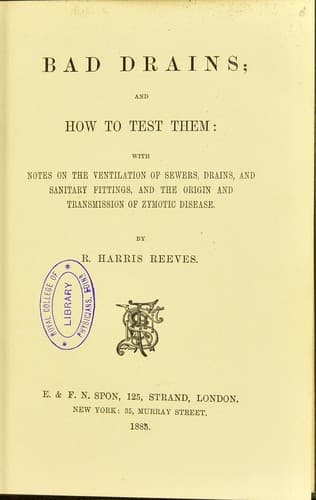
Bad Drains; and How to Test Them: With notes on the ventilation of sewers, drains, and sanitary fittings, and the origin and transmission of zymotic disease — John Shaqi
Bad Drains; and How to Test Them: With notes on the ventilation of sewers, drains, and sanitary fittings, and the origin and transmission of zymotic diseaseReeves, R. Harris
Science
Bad Drains; and How to Test Them: With notes on the ventilation of sewers, drains, and sanitary fittings, and the origin and transmission of zymotic disease
Reeves, R. Harris
Sewerage
The ventilating pipe being carried above the roof is strictly in
accordance with the bye-laws of the Local Board, although it spoils the
appearance of the house. One reason why it was put there is to prevent
the siphoning of the closet trap, and its height is to carry out the
recommendations of medical writers in the _Lancet_ who have so often
insisted that these tall pipes, carried some feet away from chimneys or
bedroom windows, were necessary.
Let us test this theory.
We will flush the closet by throwing down slops and giving the closet
the regular flush, carefully testing what takes place. The result is
that the soil-pipe, instead of carrying off the odours from the top,
only forms an air inlet, and 2¼ cubic feet of air has been sucked in at
the top of the pipe, and the same quantity of gas discharged through the
grating. As this grating on the plan is only 2 feet from the passage
door which leads into the kitchen, the least that occurs is that a
portion enters the house, and the cook has a slight headache when
preparing the meals for the day.
To be more certain of this let us test the working of the ventilation by
a dozen flushings of the closets, and the same results are obtained by
measurement, 27 cubic feet of air entered the top of the pipe, and has
been driven out at the grating below. This proves that it is unnecessary
to spoil the appearance of our houses by the erection of these pipes, or
of carrying them above the soil-pipe or closet level.
It would not be consistent for me here to state how these unsightly
pipes could be avoided, but I am confident that ere long they will
become obsolete, although they have been erected by thousands in various
parts of the country.
We will now test the working of the ventilation in drains A B, and those
in branch drains to traps marked I. As they are clear, we find that the
gases in them are not so poisonous as in the sewers to which they are
connected.
A manhole grating exists in the sewer some 40 yards from the back of the
building, and through this grating the gas which is driven by the
flushing escapes, and its density depends on the nature of the soil
passing in the sewer. Its density is lessened by diffusion, or the
mixing of the gas which takes place at the grating, but the time it
takes for the gas which is in the drain near the traps I, to mix with
the fresh air at the grating in the street is a problem that I will
leave others to solve. We are certain that no gas in bulk can pass
through the trap under ordinary circumstances.
We can now certify that the drains are tight, well trapped and
ventilated, they are laid strictly in accordance with the bye-laws of
the Local Board, and we can quote that similar plans were exhibited last
year at the Health Exhibition, as models for country architects and
builders to copy; and ninety-nine out of every hundred sanitary
inspectors would sign the certificate that the sanitary arrangements
were carefully tested, and found perfect.
Public-domain text, read in full here on John Shaqi.
Reviews
Reviews
No reviews yet
Be the first to share your thoughts on this work.
Join the Discussion
Join the discussion
Sign in to leave a comment or review.
Sign InorCreate an account