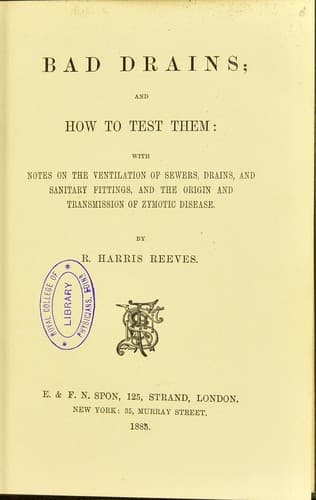
Bad Drains; and How to Test Them: With notes on the ventilation of sewers, drains, and sanitary fittings, and the origin and transmission of zymotic diseaseReeves, R. Harris
Science
Bad Drains; and How to Test Them: With notes on the ventilation of sewers, drains, and sanitary fittings, and the origin and transmission of zymotic disease
Reeves, R. Harris
Sewerage
The ventilation of buildings has received more attention than that of
sewers, excepting within the last three years.
In the ventilation of buildings we have the work and experience of Mr.
Haden, Captain Galton, Dr. Parkes, Messrs. Howarth, Tobin, Boyle,
Banner, and others, who have not only made the ventilation of buildings
their principal study, but have also spent large sums of money in
carrying out experiments with a view of getting a system of ventilation
applicable to any building. I have no doubt that each of the above
authorities in house ventilation would candidly admit that some of the
most favourable experiments they had made, and from which at the time
they expected the greatest results, had, when they had been practically
applied in different localities and under different circumstances,
proved their worst failures in providing a regular supply of fresh air
to and the extraction of foul air from any building.
If in the ventilation of buildings so many failures to get a perfect and
universal system can be recorded, it is quite natural that the same will
be the case in the ventilation of sewers.
The most eminent engineers of the present day will admit that vast
improvements must be made in sewer ventilation before they can say of a
district where a quantity of drains are laid and a large bulk of sewage
matter is carried through them, that the atmosphere of that district is
as pure as that of one where no drains are laid or where no sewage
matter can be found.
It was not until 1840 that the question of sewer ventilation received
very much attention, and it is in the reports to the City Commissioners
of Sewers and to the Metropolitan Board of Works that the earliest
results are recorded.
The report of Colonel Hayward to the City Commissioners of Sewers, dated
18th March, 1858, contains some of the earliest and most valuable
information as to sewer ventilation.
In that report it is stated that, previous to 1830, “the sewers were
ventilated by the gulleys, which were large open shafts or shoots
connected with the sewers without traps of any description: they were
connected with gratings of large size, the bars of which were farther
apart than those at present in use; there were no ventilating shafts
rising to the centre of carriageways, nor were there any side entrances
by which access to the sewers could be had. Whatever ventilation took
place therefore was effected by the gulleys, and if a sewer required to
be cleansed or examined the mode adopted was to open holes in the centre
of carriageways down to what are technically called manholes, or working
shafts, and perform these operations from these apertures, the shafts
being left open a sufficient length of time to ensure ventilation before
the men descended, and if there was fear of an accumulation of gas or
mephitic vapour, which sometimes was the case near the heads of sewers,
but at few other points in them.”
Public-domain text, read in full here on John Shaqi.
Reviews
Reviews
No reviews yet
Be the first to share your thoughts on this work.
Join the Discussion
Join the discussion
Sign in to leave a comment or review.
Sign InorCreate an account