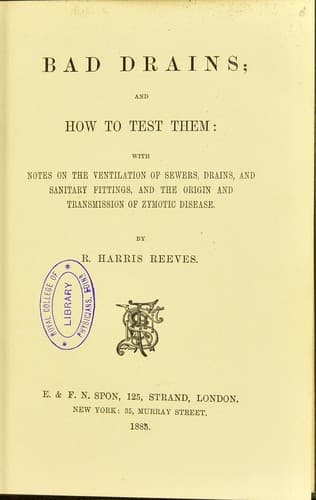
Bad Drains; and How to Test Them: With notes on the ventilation of sewers, drains, and sanitary fittings, and the origin and transmission of zymotic disease — John Shaqi
Bad Drains; and How to Test Them: With notes on the ventilation of sewers, drains, and sanitary fittings, and the origin and transmission of zymotic diseaseReeves, R. Harris
Science
Bad Drains; and How to Test Them: With notes on the ventilation of sewers, drains, and sanitary fittings, and the origin and transmission of zymotic disease
Reeves, R. Harris
Sewerage
What is here meant is, suppose that if the whole of the 6½ miles of
sewers were emptied of their gas at a velocity of 2 miles an hour, the
poisons from the sewage would not be noticeable or injurious in the
atmosphere of the drain. If each inlet to the sewer was trapped, the
opening of a water-closet or the opening of a bell trap in the sink
would not have affected the 2 miles an hour current in the sewers.
Had the currents in the sewers near the furnace of the clock-tower been
kept at 2 miles an hour, the traps being tight, and attention been paid
to the compression of the gases in the sewers by the water entering
them, the experiment would have been in a measure a successful one.
From 1855 to 1872, Sir R. Rawlinson, C.B., Dr. A. Miller, and Sir Joseph
Bazalgette were carrying out experiments with charcoal trays and
screens, and a committee of the Metropolitan Board of Works in their
report, say:—
“The results were sufficiently favourable to warrant the use of charcoal
ventilators in connection with such air-shafts as were sources of
annoyance and complaint, but their adoption had also the effect of
diminishing the upward current of foul air through the shafts and of
confining it to the sewers, thereby endangering the safety of the men
working in them, so that it is necessary that such ventilators should be
cautiously and not generally applied.”
These experiments in sewer ventilation were the most valuable of any yet
made to solve the question, but their failure could be attributed to the
following results.
The working of charcoal in the extraction of poisons given off from
sewage in its transit through the sewers, and which poisons become mixed
with the gas, and the placing of charcoal in layers or baskets so that
the gas should pass through the interstices of the charcoal, is without
a doubt the best method of dealing with charcoal as an agent in
arresting or picking up the poisons from putrid matter which is
contained in the gas. But the obstacle this gives to the supply or
exhaust of air to the sewer is greater than the power of the water-trap:
consequently traps are sucked or forced, and the inlet of fresh air
takes place through them into the sewers.
The gas from the sewer escapes through the weakest trap into the house,
thus nullifying the effects of the charcoal trays and rendering them
almost useless. The passing of the gas over the tray would prevent this,
but experiments prove that charcoal has not the power to attract and
retain the poisons from the sewage, and which is retained in the gas.
Thus these poisons pass over the charcoal through the grating into the
street.
Public-domain text, read in full here on John Shaqi.
Reviews
Reviews
No reviews yet
Be the first to share your thoughts on this work.
Join the Discussion
Join the discussion
Sign in to leave a comment or review.
Sign InorCreate an account