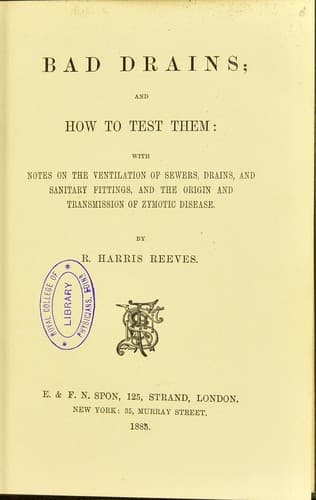
Bad Drains; and How to Test Them: With notes on the ventilation of sewers, drains, and sanitary fittings, and the origin and transmission of zymotic diseaseReeves, R. Harris
Science
Bad Drains; and How to Test Them: With notes on the ventilation of sewers, drains, and sanitary fittings, and the origin and transmission of zymotic disease
Reeves, R. Harris
Sewerage
In a small district, a girl thirteen years of age was taken with
diphtheria, and in two days after the younger brother was taken and the
other children appeared sickly. From investigation it was certain that
the poison had not been conveyed into the system by food or water. The
children generally took their meals in the kitchen, the door of which
opened into the yard, which was about 10 feet long by 8 feet wide, in
the corner of which was the W.C. I tested the atmosphere entering the
room at the bottom of the doorway, and found that it contained poisonous
matter, and on testing the closet and drains I found a hole 3 inches by
¼ inch in the closet trap. Here was the source of poison which produced
the disease. The gas in the drain was confined between two traps and in
contact with putrid sewage matter, and when it was removed no poison
from any other source could be detected. The first child that was taken
ill died, but the other recovered.
Now it is quite evident that the second child did not take the disease
from the first, as it had not time to develop. The atmosphere of the
room and the breath of the child were not as poisonous as the atmosphere
of the kitchen in a line between the kitchen fire and the door, and it
was on this line both children sat at their meals, and thus inhaled the
poison with their food. Had the gases in the other drains of the
district been of the same density as in this one, and similar leaks
existed in the sanitary fittings, diphtheria would have spread, and by
the popular theory its transmission would have been attributed to
contagion from this family, which in face of the above facts would have
been incorrect.
Another case. In a large town diphtheria broke out, and some hundreds
were attacked and over two hundred died. The source of the disease was
not in the food or water, and the only disease-producing poison that
could be found was in the gas issuing from the sewer gratings and
sanitary fittings. Schools were closed and the usual remedies used to
prevent contagion, but all to no purpose. The sewers being of an easy
gradient had silted, forming at intervals masses of putrid matter, and
in the best houses, where the disease was most prevalent, poisons from
the sewers were laid on to them by the badly-constructed drains and
sanitary fittings. The authorities at last took the matter vigorously in
hand, cleansed and sweetened the sewers as much as possible, and then
the disease abated and died out. Had contagion been the means by which
the disease was transmitted, it would have continued as it existed in
the town under almost every kind of atmospheric temperature.
Here we have evidence showing that putrid matter did exist from which
poisons were given off and their mode of transit into the body, but not
the slightest evidence to prove the poison passed direct from one person
to another.
Public-domain text, read in full here on John Shaqi.
Reviews
Reviews
No reviews yet
Be the first to share your thoughts on this work.
Join the Discussion
Join the discussion
Sign in to leave a comment or review.
Sign InorCreate an account