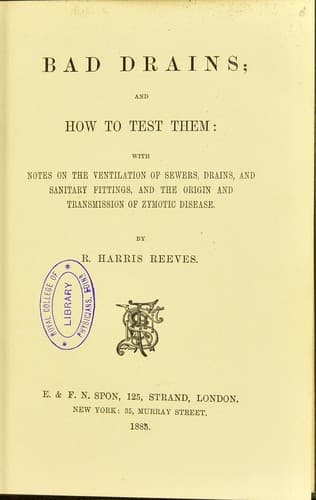
Bad Drains; and How to Test Them: With notes on the ventilation of sewers, drains, and sanitary fittings, and the origin and transmission of zymotic disease — John Shaqi
Bad Drains; and How to Test Them: With notes on the ventilation of sewers, drains, and sanitary fittings, and the origin and transmission of zymotic diseaseReeves, R. Harris
Science
Bad Drains; and How to Test Them: With notes on the ventilation of sewers, drains, and sanitary fittings, and the origin and transmission of zymotic disease
Reeves, R. Harris
Sewerage
It would be an excellent preventive if the authorities of towns would
thoroughly examine every part of their districts, and know for a
certainty whether in their sewers, cesspits, vaults, or dust-bins there
existed putrid matter, or gases from them similar to those which
produced the disease on the Continent. The expense of such an
examination and for remedying the evils cannot be an excuse for not
doing this work, as the monetary loss experienced by the residents of
those continental towns and cities by the outbreak was enormous. What
the loss would be to the residents of the metropolis if a cholera
epidemic were to occur, it is difficult to imagine, and yet in many of
the districts cholera-producing elements exist from which in all
probability the heat and atmospheric influences experienced during
several weeks of excessive dry weather during the summer months will
produce poisons of a similar vitality to those produced on the Continent
during the past year.
Previous to the cholera epidemic, small-pox was very prevalent in
London, and I very carefully noted the cases as they were reported, and
visited the districts where the disease was most prevalent, for the
purpose of testing the nature of the gases in the sewers, and observing
how the sewers and sanitary fittings were constructed.
In many of these districts, and especially those of Homerton, Hackney,
Bow, and Bromley, the drains are so laid and the fittings so constructed
that a supply of sewer gas is pumped into the houses, and it is
impossible for persons to live in the houses of these districts without
inhaling gases that have been for a long time in contact with sewage
matter.
Whether the small-pox poison is an organic one (which I believe it is),
and is produced from a collection of matter in a high state of
decomposition, with or without being mixed with the excreta of persons
suffering from the disease, or whether it is of an inorganic nature, the
poison is derived from this source rather than from the impurities
thrown off through the skin of persons suffering from the disease. As a
proof of this, as soon as the cholera broke out last year on the
Continent, almost every gulley and grating in the metropolis where sewer
gas passes was charged more or less with a disinfectant, which minimised
the poison in the gas. The result was that small-pox abated in an
epidemic form although the temperature of the atmosphere increased.
The disinfectants so placed could not, naturally, affect the gas in
branch drains to houses, or putrid matter in various parts of the
sewers, or if it had, judging from its beneficial effects at the
outlets, small-pox would have disappeared.
If contagion were the means by which this disease was distributed,
disinfectants at sewer gratings would not have prevented the disease
continuing in an epidemic form.
Public-domain text, read in full here on John Shaqi.
Reviews
Reviews
No reviews yet
Be the first to share your thoughts on this work.
Join the Discussion
Join the discussion
Sign in to leave a comment or review.
Sign InorCreate an account