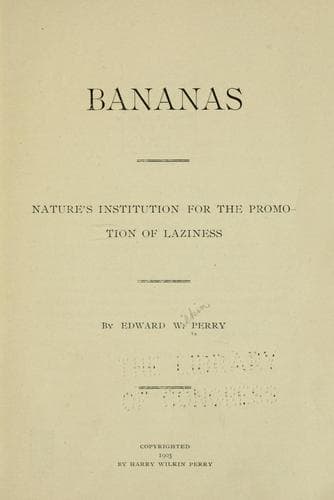
Bananas: Nature's Institution for the Promotion of LazinessPerry, Edward Wilkin
Science
Bananas: Nature's Institution for the Promotion of Laziness
Perry, Edward Wilkin
Bananas
Years ago U. S. Consul Burchard complained of the banana business of
the Honduras coast, that “A large proportion of the fruit-growers
were formerly vacqueros in the interior, working on a salary of $30
to $40 a year. They are now owners of plantations, and have a steady
income of $30 to $300 a month. The large amount of money distributed
along this coast in exchange for fruit would make any civilized and
temperate community prosperous and happy. There would be public and
private schools, churches and banks, newspapers and libraries, parks
and carriages, and handsome dwellings supplied with every comfort and
luxury, surrounded by gardens of flowers, fruits and vegetables natural
to this climate of perpetual seedtime and harvest.”
So it soon will be, for already Italian and German, Englishman and
American have accepted the invitation of a most kindly Nature, and the
sincere welcome of friendly natives, and cottages peep here and there
from out the glossy greenery, hammocks swing beneath the never-ceasing
rustle of the palms in the blessed trade winds, and the fruit of
Paradise gives to all a most generous support.
But those who have good lands back from navigable water and remote from
railroads, are not without hope of profit from bananas. For they may
dry the fruit, pack it in dainty boxes with a liberal dusting of sugar
to fill vacant spaces, and send it to the hungry millions of Europe.
This has been successfully done by planters of Trinidad and of Jamaica,
who, in at least some instances, found that they could sell the dried
fruit at 16 to 20 cents a pound. Green bunches average nearly 60 pounds
in weight, two-thirds of which is lost in peeling and drying, leaving
about 20 pounds, which, at 15 cents, will give $3 per bunch. If the
production of the green bananas and the drying should cost $2 a bunch,
the income from an acre of bananas would be $288 yearly. In practice it
has been found that the total cost and income of dried bananas give a
net return of $2.72 per bunch, which equaled about $783 per acre.
Both plátanos and guineos, or ordinary yellow bananas, may be
profitably dried or made into flour. This will utilize the surplus
fruit and such bunches as are too small to sell to advantage. Frequent
mention is made by Stanley, of banana flour in his “In Darkest Africa.”
He strongly indorses its nutritive qualities, and wonders that the
natives did not appear to have discovered what invaluable nourishing
and easily digested food they had in the plátano and banana. He
expressed the conviction that, “If only the virtues of banana flour
were publicly known, it is not to be doubted but it would be largely
consumed in Europe. For infants, persons of delicate digestion,
dyspeptics and those suffering from temporary derangement of the
stomach, the flour properly prepared would be of universal demand.
During my two attacks of gastritis a light gruel of this, mixed with
milk, was the only matter that could be digested.”
Public-domain text, read in full here on John Shaqi.
Reviews
Reviews
No reviews yet
Be the first to share your thoughts on this work.
Join the Discussion
Join the discussion
Sign in to leave a comment or review.
Sign InorCreate an account