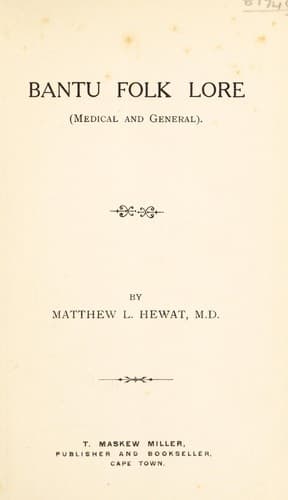
Bantu Folk Lore (Medical and General)Hewat, Matthew L.
Science
Bantu Folk Lore (Medical and General)
Hewat, Matthew L.
Pondo (African people); Traditional medicine -- South Africa; Xhosa (African people); Zulu (African people)
As one would expect there is a gradual evolution amongst the natives of
the Bantu tribes, from the Priest, pure and simple, to the “Medicine
man” proper; one who leaves the supernatural out of his method of
treatment and depends on nature and combination of nature’s products
for the cure of disease. Thus we have the “Isanuse,” the witch doctor,
diviner of secrets, etc., and on the other hand the “Igquira
Elemicisa,” the herb doctor; some of these latter even going the length
of specializing different classes of diseases; and the “Awamatambo,”
Kaffir Surgeons.
The Kaffir Doctor may be of either sex, except in the case of the war
doctor, who is always a male; and in the puberty rites of (intonyana)
and (ubukweta), each sex is treated by a practitioner of like sex.
Some of these “doctors” inherit, or are taught the knowledge possessed
by their father or mother, e.g., the Awemiciza; others become so by
voluntary submission to rites and training, vide Isanusi, where the
process of Ukutwasa is described. They all carry on their person charms
of numerous kinds; dried lizards, tiger’s teeth, fish bones, etc.,
etc., etc., that have for them special virtues; and the large majority
claim to have power over the demons of disease; for to the
unsophisticated Kaffir, all disease is caused by “Umtagati” or
witchcraft, and although the doctor may rely on his herbs and treatment
to cure his patient, he is led to practice spells and go through
incantations to meet the evident expectations of his patients, and
perhaps more so of the relatives.
Taking a “Herb Doctor” all-round he is often a clever fellow, good at
the cure of some diseases, and his methods and principles compare
favourably with those ascribed to Aesculapius and Galen in the early
history of medicine.
The Kaffir uses a pronominal prefixual polysyllabic language, and
attention to the structure of Kaffir words is necessary in order to
understand the terms applied to the various kinds of Kaffir doctors.
“Isanuse” is a substantive term of unknown origin, meaning a witch
finder or witch doctor.
Most of the other names consist of two parts—a distinguishing part
preceded by Igqira, which means “doctor,” just as we use the term
Doctor of Herbs, the Kaffir uses that of
Singular Plural
igqira elemicisa amagqira awemicisa
the doctor of herbs. the doctors of herbs.
and so on.
The etymology may be briefly shown thus:
Singular—Iligqira, or contracted, i-gqira—the doctor.
e la imi cisa } elemicisa
who of the herbs }
Plural—Amagqira. Plural prefix—ama.
a wa imi cisa } awemicisa
who of the herbs }
There are five classes of “Doctors,” each having sub-classes.
A. The Witch doctors.
Public-domain text, read in full here on John Shaqi.
Reviews
Reviews
No reviews yet
Be the first to share your thoughts on this work.
Join the Discussion
Join the discussion
Sign in to leave a comment or review.
Sign InorCreate an account