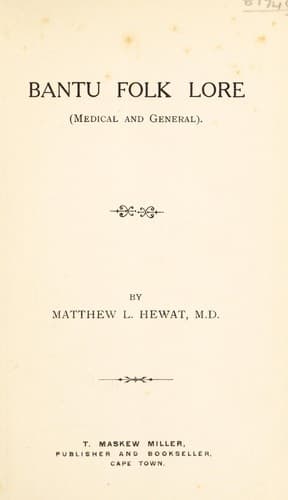
Bantu Folk Lore (Medical and General) — John Shaqi
Bantu Folk Lore (Medical and General)Hewat, Matthew L.
Science
Bantu Folk Lore (Medical and General)
Hewat, Matthew L.
Pondo (African people); Traditional medicine -- South Africa; Xhosa (African people); Zulu (African people)
The title is applied to an individual, who foresees or foretells coming
events. Some of them, from continued observations, are very able in
estimating chances or judging of future events by present and past
facts, and so come to have quite a reputation as seers. They will be
asked such things as: “Will the rains be early, late or severe? Will
the crops suffer from hailstorms? Is an enemy to be expected, when and
from where?” They pretend to be told by dreams and visions that which
they reveal, and some of them go through forms of incantations, e.g.,
throwing certain roots on a fire, &c., while using passes and phrases.
As the Kaffir prophets, like other prophets, are often wrong, the term
“Igogo” is sometimes used to mean a pretender.
They, as a rule, receive no fees.
A 4.
Singular. Plural.
Igqira elemilozi. Amagqira alemilosi.
(The doctor of Whistlings).
“Umlozi” means a whistle or whistling sound. A doctor of whistlings is
one who pretends to hear a whistling noise about, e.g., in the roof of
the hut, which gives him the instructions required as to which charms,
roots, drugs, &c., are good for a certain case, and where to find them.
He is a sort of ventriloquist and physician; does not practice surgery;
is paid the usual fees; and is usually a Fingo.
A 5.
Igqira elokuvumisa (A doctor who goes by consent). Plural—Amagqira
Awokuvumisa.
This is a consulting practitioner who does not use medicines. He will
find out what the disease is, and directs the patient to a regular
practitioner; or he will point out the sorcerer or bewitcher.
The method adopted by this individual is described under Isanusi. He,
however, is a specialist in this line. He finds out by getting the
people collected around him to Vuma, or consent to various assertions
made by himself, and judges by the loudness of their Vuma and clapping
of hands, whether he is near the truth or otherwise. See Isanusi.
A 6.
Igqira elamatambo (The doctor of bones.) Plural—Amagqira Awamatambo.
This is a class of practitioner chiefly found amongst the Basutos, who
pretends to find out things by the manner in which his “Indawuli” (Cape
Dutch—Dolossi bones) fall when thrown.
These “Indawuli” may be thus described:—
1. Two flat pieces of bone, roughly carved, i.e., the king and queen.
2. Two others, usually thicker pieces, and of the metatarsus of a calf,
also ornamented, i.e., the ox of the king and queen respectively.
3. Eight metacarpal bones of sheep, i.e., the common people.
He proceeds thus:—Holding the bones in his hands, held horizontally,
with a turn of the wrist, he throws them on the ground as one would
throw dice. He looks at their relative position. Should they give no
indication he throws again. This time perhaps they lie favourably. The
king touches one of the common people, and the queen is looking in that
direction. He then proceeds to give his opinion.
Public-domain text, read in full here on John Shaqi.
Reviews
Reviews
No reviews yet
Be the first to share your thoughts on this work.
Join the Discussion
Join the discussion
Sign in to leave a comment or review.
Sign InorCreate an account