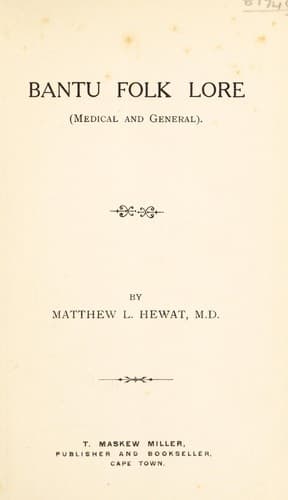
Bantu Folk Lore (Medical and General) — John Shaqi
Bantu Folk Lore (Medical and General)Hewat, Matthew L.
Science
Bantu Folk Lore (Medical and General)
Hewat, Matthew L.
Pondo (African people); Traditional medicine -- South Africa; Xhosa (African people); Zulu (African people)
A decoction of two bacteria killing plants, and controlled by a
sedative plant, is given internally in oft repeated doses. Externally a
paste of the leaves of the same plants is put around, not on the
pimples, to limit the local disease and prevent the inflammation
spreading. The pustule itself is treated by dropping the juice of a
sedative plant on it. It is left uncovered and freely exposed to the
air, and the application made from time to time until the scab falls
off. The Kaffir believes, and experience has been his guide, that the
pustule must be left alone, and meddling with it, either by incision,
excision or irritation is dangerous treatment.
1. Internally: The usual prescription is:—
Blepharis Capensis (Ubu-hlungu basigcawa) leaves and roots one part:
Cluytia hirsuta (Ubuhlungu bedila), leaves one part and Monsonia ovata
(Igqita), two parts. Use about 5oz. of this mixture made into a
decoction of a pint and take about a tablespoonful 6–8 times daily till
recovery.
2. Externally.
Blepharis Capensis 2 parts, Cluytia and Monsonia one part each. Rub up
to paste with lard and apply all round the pustule.
3. Locally.
i.e. On the pustule. The juice squeezed from the green leaves of
Monsonia.
Withania somnifera (Ubu vumba) is sometimes used instead of Monsonia.
Another method sometimes adopted is to use the Cluytia alone.
Administer an infusion, and apply a soft paste of the leaves all over
the affected part.
Other drugs used are:—a Matricaria nigellœfolia, (Um-hlonyane womlambo)
(river wormwood) used in the same way as the Cluytia.
b Xanthoxylon Capense, (um-Nungumabele) (wild cardamon), mostly taken
as a condiment with the anthractuous beef to disinfect it.
c Teucrium Africanum (Ubu-hlungu benyushu) same as Xanthoxylon.
d Solanum nigrum, (Umsobo) and
e Lippia asperifolia, (in-Zinziniba).
These two last are risky and poisonous.
Malaria. Inkatazi tonizimba, a disease sent by dissatisfied ancestors.
Treatment. Sacrifices, singing, and dancing are practised round the
sick to satisfy the ancestors.
Vomitives and purgatives are used and by some the Lasiosiphon Meisneri,
one of the “Snakebite” drugs is used, the dose being ½ oz. of the dried
root taken as an infusion.
Malaria is not a prevalent disease amongst the Kaffirs owing
principally to the fact that their kraals are always built on high
ground.
B. CONSTITUTIONAL DISEASES.
Syphilis. I-gcushiuva or I-hashe elingwevu (grey horse) to be
distinguished from I-hashe (gonorrhoea) which latter is treated by
fomentations and is not common.
The leaves of the Paramelia conspersa, (Ubu-lembu belitye) a lichen of
very bitter taste, are used in infusion, and the dry powder used on the
sores, or mixed with fat as an ointment.
In the same manner Cisampelos campensis or the Solanum melongena,
(Um-tuma) or the Withania somnifera, (Ubu-vumba) may be used and are
believed to have cured many cases.
Public-domain text, read in full here on John Shaqi.
Reviews
Reviews
No reviews yet
Be the first to share your thoughts on this work.
Join the Discussion
Join the discussion
Sign in to leave a comment or review.
Sign InorCreate an account