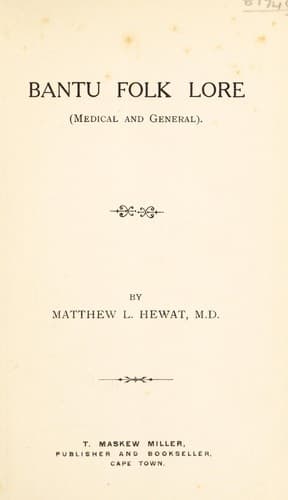
Bantu Folk Lore (Medical and General) — John Shaqi
Bantu Folk Lore (Medical and General)Hewat, Matthew L.
Science
Bantu Folk Lore (Medical and General)
Hewat, Matthew L.
Pondo (African people); Traditional medicine -- South Africa; Xhosa (African people); Zulu (African people)
The natives state that this disease was introduced by the white man,
and certainly it is within the knowledge of many that even in the last
twenty years its prevalence has greatly increased among the tribes,
probably due to the common use of drinking and other utensils and the
close and often overcrowded life led at night in the huts.
Another undoubted cause of spread is the lewd practices which
accompany, of late years, the ceremonies of Intonyane and Abakweta at
puberty.
Leprosy. I-qenqa or In-Gqinda, said to be caused by suddenly seeing the
Icanti in his natural form in the river. This suddenly seeing something
is called “Ukwalama” and a person who has thus seen the Icanti must not
talk until he has been doctored lest he take some disease such as the
I-qenqa.
Some of the Kaffir doctors blame Hottentots (an altogether different
race) for having introduced leprosy among them from the Cape Colony. It
is certainly a disease of comparatively recent occurrence amongst the
Kaffir.
Treatment. If seen in the early stages the leaves of the Umsolo omkulu,
a plant found in marshy places, are bruised and boiled. The decoction
is drunk and used as a lotion locally.
Under this treatment the sores are said to diminish or even disappear.
Note. From what I can gather the skin manifestations, are, as one would
expect, confused with other skin diseases such as eczema psoriasis &c.
Mortification. Uku fa (death.)
A case of spreading gangrene of the hand came under my notice which was
treated by a Native doctor, my patient refusing resolutely to have the
hand amputated. The method of his doctor was the following: In the
floor of a small hut a hole was dug four feet deep by one foot diameter
and this filled with soft dung, taken, warm from the intestine of an ox
killed for that purpose. The patient was laid on his side and his arm
fixed down in this hole where it was kept for ten days; the patient in
the meantime being fed freely of the ox’s meat and soup, as well as
being freely supplied with Kaffir beer. The doctor was practically
continuously in attendance all the time. Result, gangrene stopped and
spontaneous amputation at the seat of the disease, lower third of the
forearm. He informed me that the bones stuck out when his arm was
withdrawn and some sinews were adherent to the diseased hand. The bones
were forcibly broken off and the sinews cut. When I saw the wound it
was healing very slowly and he came to me to see if some salve would
not heal it.
Gangrene of parts after accident, or foul sores are all treated with
poultices, powder or ointments made from the Um-sintsi (large Kaffir
broom), Withania (Ubu-vumba) etc.
Scurvy is unknown to the native in his uncivilised state, and owing to
the large proportion of his diet being vegetable, it must be of
extremely rare occurrence.
Public-domain text, read in full here on John Shaqi.
Reviews
Reviews
No reviews yet
Be the first to share your thoughts on this work.
Join the Discussion
Join the discussion
Sign in to leave a comment or review.
Sign InorCreate an account