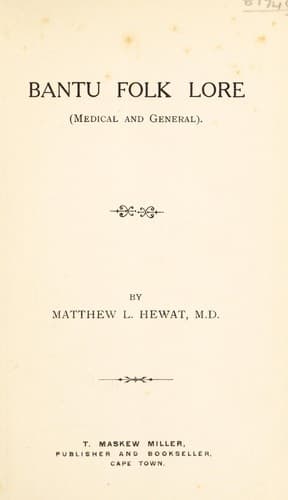
Bantu Folk Lore (Medical and General) — John Shaqi
Bantu Folk Lore (Medical and General)Hewat, Matthew L.
Science
Bantu Folk Lore (Medical and General)
Hewat, Matthew L.
Pondo (African people); Traditional medicine -- South Africa; Xhosa (African people); Zulu (African people)
Eczema. Um solo or Um-lambo.
Psoriasis. Umkondo.
Leprosy. In gquinda.
Are all looked upon as different manifestations of the same disease,
caused by coming across the Icanti. Vide “Leprosy.”
Treatment is described under leprosy.
Another method of treating these diseases chiefly Eczema is to gather
the little cones of mud raised on the banks of a stream by a small crab
or worm and rub the sores with the mud; or to collect specimens of all
the available riverside medicinal herbs, boil them, and with this
decoction freely bathe and massage the patient, after which the
remainder is taken to that part of the river where the sick man is
supposed to have been smitten, and there thrown in while the sick man
shouts something equivalent to “Don’t stare at me with those eyes.”
Lupus. Isitshangubo is treated thus:
a. Pieces of sneezewood (Umtote) are burnt and the resinous juice
(Incinde) which exudes from the ends of the stick is rubbed into the
spot while still warm. As it dries on it forms a covering, which in
time falls off with a scab. If needed the process is repeated.
b. The fleshy branches of the Isi-hlehle (a kind of Euphorbia usually
found in clusters on the ground) are bruised and the milky juice, very
caustic in action, carefully rubbed on: the process being repeated from
time to time.
Psoriasis. Umkondo, attributed to the sufferer having crossed the track
of the Icanti (see leprosy).
Treatment. Umsolo omkulu, a plant resembling the Ityolo is used here.
The leaves are, bruised, put into a vessel covered with water and
stirred briskly and for a time (Ukupehla). After much stirring a
thickish lather as of soapsuds rises and this is applied externally,
the liquor being taken in ounce doses frequently repeated.
The roots of the Ipuzi-lomlambo (Gunnera perpensa; river pumpkin) are
sometimes prepared and used in the same way.
The Um-nyanji (Phytolacca stricta), a vomitive, used much in chest
cases and also in snake poisoning is sometimes administered in small
doses and also applied externally.
Warts. In-tsumpa.
Treatment a. The milk of the Isihlehle a species of Euphorbia is
painted on the wart, and causes it to wither. b. The juice (Incinde)
which comes out of Sneezewood twigs (Um-tote) when they are burned is
used similarly. c. When large, a fine piece of hide is firmly tied
round them and they in time fall off.
Baldness. Ubu-Nquyi (a bald person In-Nquyi).
No treatment is used and a bald person is considered wise and eloquent
in speaking, and likely to be rich; but curiously enough he is expected
to become so by sly and cunning means not necessarily of a high moral
standard.
There are few Bald Kaffirs.
Amaas. A disease fairly common amongst Kaffirs, occuring in epidemics
and variously described by medical men as Small-pox i.e. in its severe
forms, or chicken-pox, in its milder manifestations. Many hold that it
is a disease sui generis.
Public-domain text, read in full here on John Shaqi.
Reviews
Reviews
No reviews yet
Be the first to share your thoughts on this work.
Join the Discussion
Join the discussion
Sign in to leave a comment or review.
Sign InorCreate an account