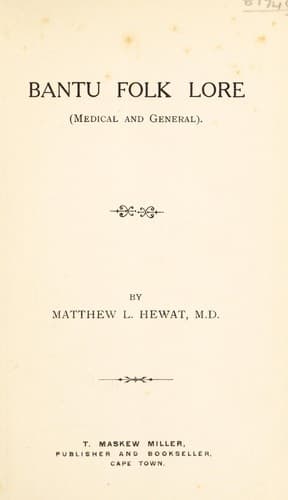
Bantu Folk Lore (Medical and General) — John Shaqi
Bantu Folk Lore (Medical and General)Hewat, Matthew L.
Science
Bantu Folk Lore (Medical and General)
Hewat, Matthew L.
Pondo (African people); Traditional medicine -- South Africa; Xhosa (African people); Zulu (African people)
Whatever the cradle of their race, the Kaffirs are now located in the
region situated between the Great Fish River, the Kathlamba or
Drakensberg mountains and their outlying spurs and subsiding ranges;
the northern boundaries of the Portuguese settlements around Delagoa
Bay, and the Indian Ocean. Those tribes most intimately connected with
the history of the Cape still occupy territory partly within the bounds
of the Colony proper—the divisions of Queenstown, Woodhouse Glen Grey,
Cathcart, Stutterheim, Komgha, King Williams Town, East London, Peddie,
Victoria East and Fort Beaufort—and partly in the region lying between
the North Eastern Frontier, Basutoland, Natal and the Ocean and known
as the Transkeian territories of Tembuland, Pondoland and East
Griqualand. They are named as follows: Aba-Tembus ama-Mpondo,
ama-Mpondumise, ama-Ntinde, ama-Ngqika, (Gaika), ama-Ndhlambe and
ama-Gcaleka. The three last spring from one large tribe, the
ama-Rarabe, and comprise with the ama-Ntinde the “fighting ama-Xosa” of
the Kaffir Wars. These are the tribes to which Dr. Hewat’s researches
more particularly refer. Their chiefs trace back their origin to the
common ancestor Zwide who lived about Cromwell’s time, perhaps earlier.
There are a few isolated and comparatively insignificant classes who
have separated through feuds and quarrels from the main tribes, or have
mingled with the Hottentots by inter-marriage, such as the ama-Qate (or
ama-Xesibe), ama-Baca, and ama-Gqunukwebe; and we must not omit to
mention the ama-Bele, ama-Zizi, and aba-Mbo classes who were formerly
large tribes occupying at one time Natal and perhaps Zululand and from
whom are derived the Fingoes of the Cape Colony—also referred to by Dr.
Hewat—the Natal Kaffirs, the Zulus, and the Matabele of Rhodesia.
The aba-Xosa and aba-Tembu tribes with whom we first came into contact,
the pioneers of the Kaffir advance southward are supposed to show least
modified and developed the distinguishing characteristics of their
race. Their lighter colour argues a slight admixture of Hottentot blood
and their intercourse with this race was doubtless considerable. From
it they have borrowed the clicks which distinguish their speech from
other Bantu dialects. In other respects their language is archaic and
free from phonetic decay compared with that of other tribes such as the
Swahili. Their pursuits were exclusively those of the hunter and
herdsman, war and hunting were their pastimes, cattle tending and
cattle rearing the serious business of their lives. Indeed cattle
mainly constituted their wealth and everything connected therewith was
deemed of the highest importance. Herding and milking were privileged
labours jealously confined to the men, who also took much pride in
training oxen for racing purposes.
It is not surprising to find therefore that their skill as veterinary
surgeons was considerable and quite equal to that which Dr. Hewat has
shown they possess as medical practitioners and surgeons.
Public-domain text, read in full here on John Shaqi.
Reviews
Reviews
No reviews yet
Be the first to share your thoughts on this work.
Join the Discussion
Join the discussion
Sign in to leave a comment or review.
Sign InorCreate an account