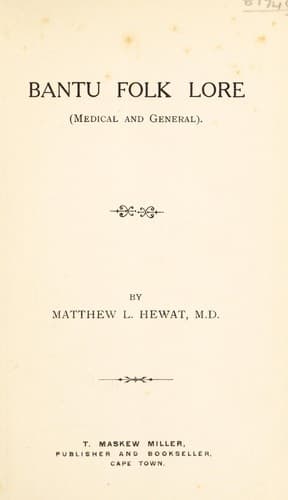
Bantu Folk Lore (Medical and General)Hewat, Matthew L.
Science
Bantu Folk Lore (Medical and General)
Hewat, Matthew L.
Pondo (African people); Traditional medicine -- South Africa; Xhosa (African people); Zulu (African people)
Ubuhlungu besigcawu (Blepharis Capensis)
Um-tumana (Solanum Capense)
Isi-dikili (Lasiosiphon Meisneri)
Root of Indegofera potens.
All having distinct antiseptic and anæsthetic values.
The Kaffir surgeon or domestic sympathiser tries to extract the
offending tooth by means of a strip of thong tied to it.
Speaking generally the Kaffirs have splendid teeth and take great care
of them by frequent cleansing.
Headache.
a. I-yeza Elininyama (Anemone Caffra) is used; the root being dried,
powdered and used as a snuff. Should this fail the upper rootstalk is
burned and the smoke inhaled; while a paste of the leaves is rubbed
into or bound on the affected part.
b. Um-hlavutwa (Ricinus communis) is also used externally as a paste
and internally in decoction.
A common practice is to bind the head firmly with a thong.
H. DIGESTIVE SYSTEM.
Thrush. Ama-vila, said to be caused by the child eating green mealies
off the cob and leaving its saliva on a cob that is accidently burnt;
or putting its father’s pipe into its mouth.
Treatment. The mouth is frequently washed out, either with an infusion
of the leaves of Isi-duli (Brachylæna elliptica) or an infusion of
Mimosa bark.
Quinsy. Um-qala. Gargles are used of hot infusions of Isi-duli, Mimosa,
or bitter olive tree, etc.
Diphtheria. I have no record of this disease being recognised by the
Kaffir as anything but sorethroat Umqala, if it occur at all.
Dyspepsia and Indigestion. I-dliso.
Believed to be caused by eating poisonous foods, and usually treated by
emetics e.g. In-kamamasane (Euphorbia pugniformis) one of the class of
drugs known amongst the natives as Intsema, acting as a severe emetic
and purge. The juice tapped from the living stem of these plants is
collected in maize meal and made into a bolus to be swallowed; about
half a drachm of the drug being taken at a time. As this is nearly as
severe as croton oil, the action is easily to be understood and in a
country and nation where at times great overfeeding and gorging is
practiced, such a treatment is a valuable asset.
Another favourite purge is Um-gwali (Euclea lanceolata), the bark of
the roots being used.
Colic. Uku kunywa or I-honya.
Treatment. a. The Powdered root of In-nyongwane, (Deconia anomala) is
administered in cold water.
This plant is also put to a curious use by the Kaffir. When visiting a
strange place he eats some of it, believing that if he gets poisoned
food he will immediately vomit it.
b. The knobs from the roots of the in-dawa (Cyperus) are used, either
chewed as they are or as an infusion of the powdered knob. It has an
aromatic pungent taste.
c. The powdered root of I-qwili (Alepidea amatymbica) is also used for
colic or abdominal pain, a teaspoonful to a dose.
In larger doses this drug is an emetic and purgative, in smaller a
stomachic.
d. Um-bangandlela (Heteromorpha arborescens) is also used in infusion.
Public-domain text, read in full here on John Shaqi.
Reviews
Reviews
No reviews yet
Be the first to share your thoughts on this work.
Join the Discussion
Join the discussion
Sign in to leave a comment or review.
Sign InorCreate an account