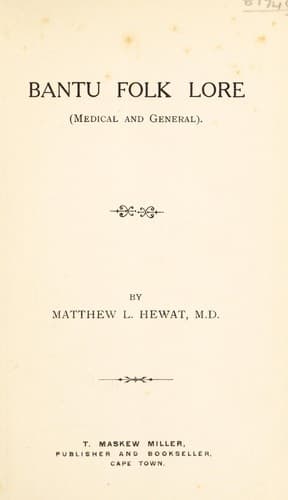
Bantu Folk Lore (Medical and General)Hewat, Matthew L.
Science
Bantu Folk Lore (Medical and General)
Hewat, Matthew L.
Pondo (African people); Traditional medicine -- South Africa; Xhosa (African people); Zulu (African people)
Purgatives are used and sometimes injections. This is one of the
diseases which lend themselves so well to the treatment of the Amagqira
Awokuqubula or doctors who use massage and sucking accompanied by
incantations, and profess to produce, in the form of a lizard, frog, or
something, the cause of the disease.
The Awobulongo, cow-dung doctors are also successful in this illness.
Stitch. Ili-hlaba is treated by rubbing the part and administering
infusions of the root of the Ili-bulawa (Sebæa crassulæfolia), a bitter
astringent used also in dysentery and colic.
Vomiting. In-hlanzo, caused by bewitchment or poisoning is arrested by
copious draughts of hot water followed by purgatives.
Dysentery or Diarrhœa. Uxaxazo referred to gastronomic errors and
treated by:
a. I-yeza lezikali (Pelargonium reneforme) administered hot as a
decoction in milk of the powdered root, about a teaspoonful of the
powder.
b. Um-tuma (Solanum Capense) as in (a).
c. I-gqita (Monsonia ovata). Much used and valued in this disease. It
is sedative and astringent and now used as a tincture in the
armamentarium of most colonial physicians, and by some considered very
valuable in Typhoid fever.
Jaundice. I-nyongo (bile) believed to be due to too long continuance of
the same diet.
Treatment: Diet is changed and purgatives administered.
Gallstone and its colic are not recognised.
Constipation. Uku-qunjeliva.
Treatment: 1. Sometimes enemata are administered. The method adopted
being, to insert the smaller end of a cowhorn, with the point cut off,
into the bowel and having filled the horn with the required liquid to
blow with the mouth applied to the other end and so empty the horn of
its contents into the bowel.
2. Many purgatives are known and used, the chief being a. Um-quali
(Euclea lanceolata) of which the bark of the roots is used.
b. In-kamamasane (Euphorbia pugniformis) The milk from the stem is a
drastic cathartic, and like croton oil an escharotic.
c. Um-hlaba (Aloe ferox). The long fleshy leaves of this plant are
broken off and hung up in a sun over a vessel. The juice which collects
is dried in the sun, and being mixed with meal or clay is used in the
form of a pill.
In some parts the juice of this aloe is used by the natives, dropped
into the eye, for purulent ophthalmia.
There are many other cathartics known to and used by the native doctors
as well as domestically.
Obstruction of the bowels. Uku-quina.
Treatment: All the usual cathartics may be tried and they failing, the
rubbing doctor “Igqira-elokuqubula,” may be called in who massages the
belly. If he fails the person must be bewitched; when the witch doctor
is requisitioned to see the end of the chapter and have someone
punished for the result.
Peritonitis. Inflammation of the bowels is treated generally as colic
and fever.
Public-domain text, read in full here on John Shaqi.
Reviews
Reviews
No reviews yet
Be the first to share your thoughts on this work.
Join the Discussion
Join the discussion
Sign in to leave a comment or review.
Sign InorCreate an account