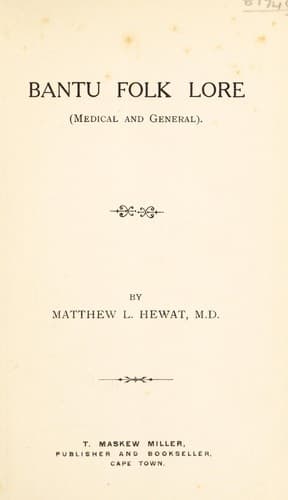
Bantu Folk Lore (Medical and General) — John Shaqi
Bantu Folk Lore (Medical and General)Hewat, Matthew L.
Science
Bantu Folk Lore (Medical and General)
Hewat, Matthew L.
Pondo (African people); Traditional medicine -- South Africa; Xhosa (African people); Zulu (African people)
A person suffering from prolonged debility unrelieved by treatment,
naturally (for a Kaffir) comes to believe that he is under the malign
influence of someone around him who is working on him by means of
witchcraft, and journeys are taken to get away from the spell. Thus in
a way the idea of “Change of Air” is practiced.
CHAPTER V.
SURGERY.
Fractures. The Kaffir Surgeon (Igqira Elokuqapula) is fairly expert in
such cases and carries out a routine treatment. The usual drawing out
of the limb is performed, replacing any noticeable deformity. It is
then held in position while the surgeon makes three parallel incisions
over the seat of fracture. Into these incisions he rubs the ashes
derived from burning the roots of certain plants “awatunga” of which
one is the plumbago. The limb thus treated is then bound firmly with
strips of the inner bark of the mimosa tree which form an excellent
splint material. Some surgeons profess to know a “bone root” which
taken internally promotes rapid healing. I have been unable to identify
this. It is just possible that this incising and rubbing in of charcoal
acts as a counterirritant and thus prevents inflammatory mischief of
deeper structures. The selection of carbon in preference to other
substances shows at least a rudimentary knowledge of an antiseptic
substance being preferable.
Internally purgatives are administered to promote healing and ease
restlessness.
Dislocations. Are not generally differentiated from fractures.
Healing Wounds. Sufferers from extensive wounds are usually taken to
the top of a neighbouring hill and there kept in a newly built hut. (It
would seem that some tradition had taught these people that wounds heal
best in fresh air and cleanly surroundings).
In-kubele (Kaffir generic name for healing plants) are frequently used,
thus:—
a. The wound is sometimes dressed by the application of the leaves of a
small white Lily soaked in brandy or Kaffir beer.
b. The leave of the Ungcelwane (Aloe latifolia) is cut open and the
inner surface applied to the wound. The juice of this is pungent and
has a marked healing effect.
c. Swollen and inflamed wounds are poulticed with U-nomolwana (mallow
leaves in paste), which soon reduces the inflammation or brings the
abscess to a point. When the wound is cleaned in this way it is washed
with a decoction of mallow leaves made in an earthenware vessel (not a
metal pot) and an application made of one of the in-kubele (healing
plants), e.g., The leaves of the Pelargonium alchemilioides in the form
of a paste.
I have the record of a man with a perforating ulcer of the foot, who
refused amputation and who was ultimately cured by a Kaffir surgeon.
d. Callous ulcers or slow healing wounds are treated by applying the
juice of the Isi-dikili (Lasiosiphon Meisneri), which acts as a pretty
considerable irritant and answers its purpose admirably. It is also
used internally in infusion as an alterative and blood purifier.
Public-domain text, read in full here on John Shaqi.
Reviews
Reviews
No reviews yet
Be the first to share your thoughts on this work.
Join the Discussion
Join the discussion
Sign in to leave a comment or review.
Sign InorCreate an account