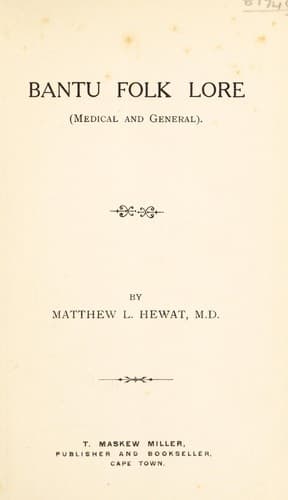
Bantu Folk Lore (Medical and General)Hewat, Matthew L.
Science
Bantu Folk Lore (Medical and General)
Hewat, Matthew L.
Pondo (African people); Traditional medicine -- South Africa; Xhosa (African people); Zulu (African people)
e. The leaves of the Iyeza lezikali (Pelargonium-reniforme) when boiled
yield a mucilage that is applied on and around wounds to protect them
from flies which in this climate rapidly breed maggots in unhealthy
sores.
f. The leaves of the Ubu-shwa (Venidium arctotoides) are used for
callous ulcers after they have been scarified.
g. A paste of the leaves of I-dwara (Senecio latifolium) is used.
h. Um dambiso (Senecio concolor) also used in the form of a paste of
the mashed leaves.
i. An ointment made by boiling in lard the leaves of the Ubu-vumba
(Withania somnifera) is frequently applied in painful cases.
Burns. The following is a graphic description of the mode of treating
burns, given me by a Fingo. It is certainly not a gentle one. Here is
the case of a child who through carelessness has fallen into the fire
and lies screaming. It is found on examination to have a severely
burned arm and shoulder. The father takes the case in hand. He goes out
and secures some in-kubele (healing plants) and one or two mealie cobs
(the centre of the Indian-corn cob after the grain has been removed).
He has some water boiled and is now ready to commence operations. The
child is laid over his knee, while the mother stretches out the injured
arm and holds it firmly. The whole of the charred and injured tissues
are firmly rubbed off with the mealie cob, which has been soaked in the
hot water, until the wound is considered clean.
The screams of the child are not considered of any importance compared
with the scraping process which must be thorough.
The wound is then freely dressed with the leaves or mashes used in
healing wounds.
Tumours and Abscesses. Ama-fa, quba or i-tumba are looked upon as
collections of bad blood growing out. They, especially if painful are
treated by poultices of various herbs (vide healing wounds) and if they
point are frequently incised and evacuated.
Large tumours are not touched and are considered, in some tribes, to be
due to the touch of a bewitcher.
Lightning Stroke. The Basutos attempt resuscitation in cases of
apparent death from lightning stroke. They lay the person on his back,
extend his arms and make rythmical traction on the tongue, the while
the body and limbs are being well rubbed. Amongst most tribes a person
killed by lightning is looked on with great awe and as a rule no one
will touch him. The Isanusi is called, and after many incantations and
purifyings, a hole is dug near him and the body rolled into it. The
spot is then “Isitshu,” sacred and enchanted. The whole kraal is then
put in “Coventry” and no communication allowed with anyone, neighbours
or visitors, for months. An isanuse is then engaged, paid a large fee
and proceeds to purify all the people in the kraal by means of
ceremonies and incantations.
A beast, cow, ox etc., killed by lightning is treated in the same way
(buried whole and untouched), and the kraal avoided.
Public-domain text, read in full here on John Shaqi.
Reviews
Reviews
No reviews yet
Be the first to share your thoughts on this work.
Join the Discussion
Join the discussion
Sign in to leave a comment or review.
Sign InorCreate an account