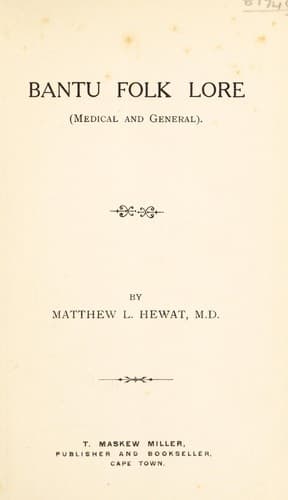
Bantu Folk Lore (Medical and General) — John Shaqi
Bantu Folk Lore (Medical and General)Hewat, Matthew L.
Science
Bantu Folk Lore (Medical and General)
Hewat, Matthew L.
Pondo (African people); Traditional medicine -- South Africa; Xhosa (African people); Zulu (African people)
The child is then taken up by the father, who is usually present, and
handed to the mother. When the ceremony is over, on leaving the spot,
no one dare look back, lest the efficacy of the charm be spoiled. This
operation is supposed to instil courage into the unwitting heart of the
little one; such courage, that even when lightning, the most fearful of
all Silos (beasts) is flashing on every side, and the thunder roars as
if the very earth would burst, he or she may not momentarily close an
eye.
The temporary burying of a child at a later age is thought to be a
deterrent of diseases more especially of fevers and colds.
Mothers of children take their little ones, of any age up to five or
six years, early in the morning some little distance from home, and dig
holes in which each child is placed separately, and into which earth is
thrown until the child can only move its arms and head, the body being
in an upright position. The mothers then walk away, singing songs and
behold them from afar, when they return and release them.
Another charm to prevent sickness is one which is sometimes called
“Umtshopi.”
Young maidens are here the performers. When “Umtshopi” is to be played,
these maids rise early in the morning and go to some brook or riverside
where grows, a kind of long, broad leaved rush, which they pull, and
fashion into a fantastic kind of dress, thus:—
A rope is plaited sufficient to go round her waist, on this she works
the reeds, so as, to form a fringe or kind of kilt which will touch the
ground when she moves. Another is made to fasten round the chest under
the arms, and a third thickly worked is worn round the neck so as to
conceal the arms and bust. A hat is then made in the same manner, only
the rushes are burned so as to stand up, thus giving the girl in this
green costume, the appearance of a moving bunch of grasses.
Each girl being thus arrayed, they set out on a round of calls to the
kraals of the neighbourhood. Each chants a weird song, dancing,
gyrating in a most fantastic manner, frequently increasing the effect
of their grotesque appearance by wild whoops and unearthly yells, until
the smaller children begin to scream of sheer fright; for now the
mothers forcibly lay down on the ground all the younger ones, who
cannot be persuaded to do so, and an Umtonjane jumps over each one,
from the tiny mite just learning to crawl, to urchins of from twelve to
fourteen years of age.
After all the little ones of the kraal have been “jumped” the
performers go off and kindling a fire, burn their “Umtshopi,” a process
of some difficulty and duration owing to the greeness of the reeds. Any
garment or ornament which a girl may happen to wear while playing
“Umtshopi” must be burnt, otherwise the efficacy of the charm is quite
destroyed.
Public-domain text, read in full here on John Shaqi.
Reviews
Reviews
No reviews yet
Be the first to share your thoughts on this work.
Join the Discussion
Join the discussion
Sign in to leave a comment or review.
Sign InorCreate an account