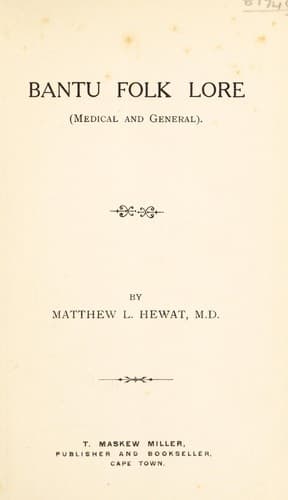
Bantu Folk Lore (Medical and General)Hewat, Matthew L.
Science
Bantu Folk Lore (Medical and General)
Hewat, Matthew L.
Pondo (African people); Traditional medicine -- South Africa; Xhosa (African people); Zulu (African people)
Two months after the birth of the child the mother reappears in public;
but should the child be still-born, after a shorter interval.
So much for the mother who usually recovers without much trouble.
The Newborn Infant is, to say the least of it curiously treated.
Dr. Casalis in recording the birth of 490 Basuto Children, states that
of these 160 die in infancy, and one is not surprised when one
considers the trying ordeals of their first few days of life.
No sooner is the baby born than the points of its fingers are bled for
luck. The infant is then held in the smoke of a slow fire of aromatic
woods till it sneezes or coughs to show that it is not bewitched. Then
commence its ablutions. It is first thoroughly rubbed all over with a
solution of cowdung and then rubbed clean as possible and rolled in the
skin of a goat or sheep recently killed.
Then commences a course of treatment that is in violation of all laws
of nature and propriety.
Instead of the infant being allowed to use the mother’s milk
“amasabele,” they give it sour curdled milk (a sort of koumiss or
calabash milk) from the cow, the same as that used by adults. This they
force down the throat of the poor little mortal by blowing it into its
mouth and compelling it to swallow. This is continued for three days,
and as a result the bowels become much distended and bowel complaint,
often ending in death, frequently results.
They do this as they believe that the new “Amasebele” new mother’s milk
would cake in the stomach, corrode it, and cause premature decay.
So that if a child be sickly the doctor often ascribes it to the child
having been fed on mothers’ milk too early, which must be purged away
by a course of medicine.
At the end of three days the infant is allowed to take the amasebele or
breast milk. During these three days if necessary, the breasts are
milked by hand.
The Kaffir, not content with the above extraordinary treatment is in
the habit of administering drugs to the newborn infant.
Thus on the day of its birth as a purgative, an infusion made by
steeping in cold water the tubers of the U-jyane (Chlorophyton comosum)
is administered. This is a common infantile aperient but when it is not
obtainable, a paste of the leaves or an infusion of the leaves of the
U-sikiki (Salvia scabia) is administered for the same purpose.
The Zulus have some curious practises, with regard to children.
At the age of about ten days the first “charm” is worked. It consists
of partly burying the infant at some spot near where lightning has been
known to strike. The hole need not be more than a few inches deep. The
mother places her naked infant in the hole, when the Isanuse chewing
some medicine roots, squirts it over the child, muttering an
incantation as he does so.
Public-domain text, read in full here on John Shaqi.
Reviews
Reviews
No reviews yet
Be the first to share your thoughts on this work.
Join the Discussion
Join the discussion
Sign in to leave a comment or review.
Sign InorCreate an account