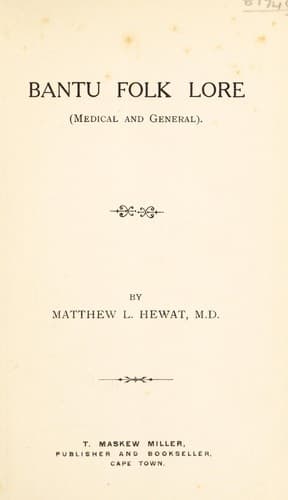
Bantu Folk Lore (Medical and General)Hewat, Matthew L.
Science
Bantu Folk Lore (Medical and General)
Hewat, Matthew L.
Pondo (African people); Traditional medicine -- South Africa; Xhosa (African people); Zulu (African people)
One must not however jump to the conclusion that the average Mosuto has
raised himself in intellectual capacity or freedom from sensualism and
superstition far above the other Bantu tribes. Good government has
however so improved his material condition and raised his standard of
comfort that it may at least be said that the seeds of civilization are
sown on favourable soil.
I am indebted to Mr W. Hammond Tooke, of the Cape Civil Service, for
the foregoing facts relating to the ethnology of the “Bantu Tribes.”
CHAPTER II.
SOME OBSERVATIONS OF INTEREST IN THE FOLK LORE OF THE KAFFIR.
Before proceeding to enumerate and describe the diseases, as recognised
by the natives, their cures and what the Kaffir believes to be their
causes, there are several subjects that are of interest in the study of
Kaffir Folk Lore which I propose shortly to notice.
The Kaffirs, would be a healthy, long lived people were it not for the
excesses of riot they run, in the practice of adultery, drinking,
dancing, etc. Their mode of living on simple mixed diet, and
practically entirely in the open air, in a fine climate is exceeding
favourable to robust health and longevity and perhaps no nation enjoys,
on the whole, better health.
When disease does occur in man or animal it is almost invariably
ascribed by the Kaffir to the agency of human beings, either a living
person or as often as not some departed relation who has used
witchcraft or “Umtagati.”
Even the vast majority of Mission or school natives who are more or
less educated, retain this belief, so deep is it rooted in the native
mind, in spite of the fact that Missionaries have preached against it
for years.
Throughout South Africa the practice of witchcraft is a criminal
offence and severely punished; nevertheless the belief remains, and
witchcraft, and “Smelling out” are carried out in secrecy. Many hut
burnings and solitary murders being undoubtedly traceable to this
practice.
It is a well recognised fact amongst those living in the Native
Territories that of all the deaths amongst cattle that have taken place
there in the recent epidemic of Rinderpest probably nineteen out of
twenty have been ascribed to witchcraft.
From the foregoing it will be seen that it is, to the Kaffir, possible
that anyone may attain power over disease and inflict a fellow being,
usually by calling in the assistance of the Ghosts of the departed, or
of natural spirits or demons. It will be observed when studying the
methods of curing disease that many of the cures are for the purpose of
driving out the bewitching spirit. Just as in the ancient folklore of
England offensive drugs were administered etc. for this purpose so it
is at the present day in native practice.
The Natives believe that several agencies are often the chief cause of
disease and have much power over the sick person.
The chief of these are. 1. Icanti. Uhili or Tikoloshe and Im-pundulu.
2. Im-paka. 3. U-buti (poison).
Public-domain text, read in full here on John Shaqi.
Reviews
Reviews
No reviews yet
Be the first to share your thoughts on this work.
Join the Discussion
Join the discussion
Sign in to leave a comment or review.
Sign InorCreate an account