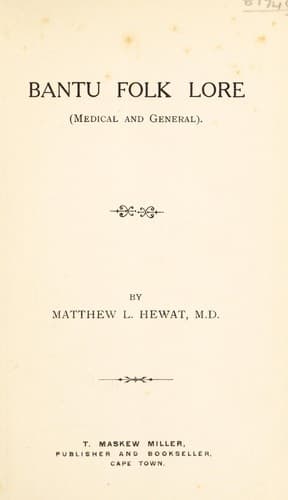
Bantu Folk Lore (Medical and General)Hewat, Matthew L.
Science
Bantu Folk Lore (Medical and General)
Hewat, Matthew L.
Pondo (African people); Traditional medicine -- South Africa; Xhosa (African people); Zulu (African people)
These relatives are therefore forever looked upon with suspicion, and
are frequently “smelled out” as the cause of bewitching in subsequent
events. They are often severely tortured, sometimes fatally, in order
to get them to confess their sins. One of the chief methods of torture
is to tie them inside the hut while it is kept filled with dense
pungent smoke.
Superstition pervades the whole of the Bantu family. They all believe
in the spirit world and the resurrection from the dead even of the
lower animals.
They believe that a new state of things is going to be, only in a
different way from that generally understood by certain christian
nations. It will be remembered that at the great “Cattle Killing Craze”
of the Kaffirs, they believed, as told by their seer, that their
ancestors would all come back on a certain day and help them to drive
the white people into the sea. So that they would again come to inherit
the land.
Sacrifices. “Idini” are offered by the “Medicine man” to appease the
wrath of the offended spirits of ancestors, who are supposed to have
caused the sickness of a patient or some such calamity. It being
thought that they can by thus appealing to the pleasure of the
“imi-Nyanga” (ghosts), buy them off or secure future immunity.
The following circumstances are instances of cases demanding
sacrifices: e.g.
1. Should anyone dream about his ancestors who are dead; that was taken
as an indication, that they were displeased at some neglect and
demanded an “Idini.”
2. Should there be illness either of man or beast, and a doctor
(Isanuse) be called in and declare, “I see your ancestors. They are
angry because you have not rendered them their due”; it was understood
that an “Idini” was required.
3. Should there be a scarcity of rain, the people would go to the chief
and say, “Why do you allow this drought to go on? Why do you not
approach your ancestors”; when a great sacrifice would be offered.
The most common method of offering a sacrifice is the following:—
Fuel is first prepared, consisting of chips of “Sneezewood,” a very
hard, slow burning wood.
An ox is slaughtered in the centre of the cattlefold in the afternoon,
and the blood carried over to the hut of the person, who requires the
sacrifice. Who, for instance, has dreamt about his ancestors or whose
relative is ill, etc., and deposited in a Kaffir basket (these baskets
are watertight) at the back of the hut. In carrying it, drops are
purposely allowed to fall on the way, as a guide to the spirits from
the hut to the Kaffir kraal, where on the morrow the ceremony is to be
performed. The rest of the carcase is carried in sections to the hut,
and piled up in the centre on sneezewood and laurel twigs.
Public-domain text, read in full here on John Shaqi.
Reviews
Reviews
No reviews yet
Be the first to share your thoughts on this work.
Join the Discussion
Join the discussion
Sign in to leave a comment or review.
Sign InorCreate an account