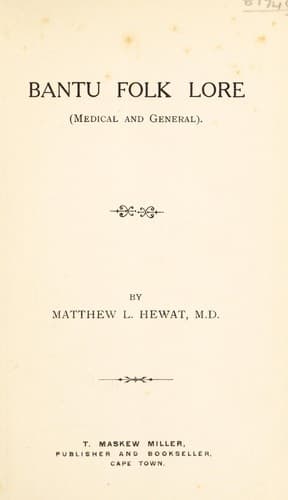
Bantu Folk Lore (Medical and General) — John Shaqi
Bantu Folk Lore (Medical and General)Hewat, Matthew L.
Science
Bantu Folk Lore (Medical and General)
Hewat, Matthew L.
Pondo (African people); Traditional medicine -- South Africa; Xhosa (African people); Zulu (African people)
5. Mamlambo. This is another snake chiefly known by Zulus and used by
them as a charm. If not properly used it causes sickness or death, and
has come to be looked on as a possible cause of sickness in many cases.
6. Omitting to observe certain ceremonies or rites is supposed to cause
umbrage to the spirits and thus, bring about illness. Thus if the
finger of a new born infant is not cut, the infant will be sickly and
die young.
If “circumcision” in man or “Intonjane” in woman is omitted the
Imishologu (spirits of the dead) are dissatisfied and disease or
barren-results.
7. Etc. Certain superstitions are attached by the Kaffir to a number of
things or practices; for example.—Heaps of stones, which they call
“Isivivane,” a stone lifted from the path and placed on the branch of a
tree; a heap of small dry sticks placed by the road-side; tying the
long grass by the wayside into knots; chewing certain leaves, roots, or
barks, of certain plants; or wearing these last; crossing certain
streams, especially in the case of women or children; washing in or
drinking of certain pools or streams; dogs howling at night; owls
hooting as if from the top of cattle or hut etc.
They also have superstitions about the bird “Broomvogel” or “Intsikizi”
e.g.: it is terribly unlucky to kill one; about a cow or ox entering a
hut or a calf lying down when its mother is being milked; about the
killing of the Umntanizulu or mantis, the insect called the
“Hottentots God” by the Boers. And many other things or acts of like
nature into the description of which it would be foreign to the present
subject to enter.
The following superstition and practice with reference to the dead
existed in the early times, though it is seldom heard of now. When the
head of a family died without saying where he was going e.g. suddenly;
immediately after his expiring the sons or daughters were compelled to
place a piece of old leather or some similar thing between his teeth or
into his mouth to show that he had died unhappily, in consequence of
being bewitched. This had the effect of bringing all his acquaintances
under suspicion of having bewitched him and the general public were in
great danger of being accused by the “Isanusi” of witchcraft. The death
of such an one is at once reported at the “great place” and the chief
despatches a number of men to the kraal to seize and confiscate all his
property and cattle.
The belief is that a person dying under these circumstances had gone to
a place of punishment; but the Amaxosa have no name for it. They, have,
however a name for a happy place although they cannot describe it.
The superstitious idea attached to the death above referred to, is that
the soul of the dead man, being dissatisfied is likely to inspire his
children or near relatives with a spirit of witchcraft and that they
are likely to become a public danger in consequence.
Public-domain text, read in full here on John Shaqi.
Reviews
Reviews
No reviews yet
Be the first to share your thoughts on this work.
Join the Discussion
Join the discussion
Sign in to leave a comment or review.
Sign InorCreate an account