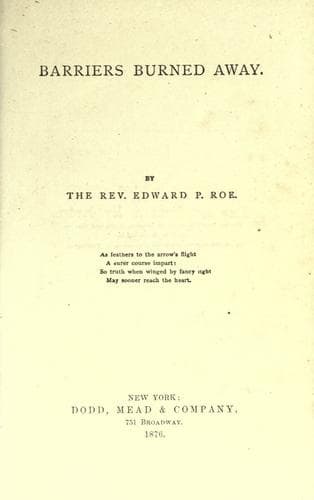
Chicago (Ill.) -- History -- To 1875 -- Fiction; Fires -- Fiction; Great Fire, Chicago, Ill., 1871 -- Fiction; Historical fiction
The patter of feet was heard on the kitchen floor, the door opened,
and two little figures in white trailing nightgowns entered. At first
they looked in shy wonder and perplexity at their tall brother, whom
they had not seen for months, but at his familiar voice, recalling
many a romp and merry time together, they rushed to his arms as of old.
Then they drew near the bed to give their father his accustomed morning
kiss; but, as they approached, he seemed so still that awe began to
creep over their little faces. A dim recollection of the farewell kiss
given a few hours before, when they were scarcely awake, recurred to
them.
"Father," said the elder (about five), "we want to give you
good-morning kiss."
Seldom had their father been so sick or irritable but that he reached
out his arms to his little ones and gave them a warm embrace, that did
him more good than he realized. The influence of trusting children is
sometimes the most subtile oil that can be thrown on the troubled
waters of life.
But as the little ones saw that their father made no response to their
approach and appeal, they timidly drew a step nearer, and looked into
his wasted, yet peaceful face, with its closed eyes and motionless
repose, and then, turning to their mother, said in a loud whisper,
with faces full of perplexity and trouble, "Is papa asleep?"
The little figures in their white drapery, standing beside their dead
father, waiting to perform the usual, well-remembered household rite,
proved a scene too touching for the poor mother's self-control, and
again she gave way to a burst of sorrow. But her son, true to his
resolution to be the stay and strength of the family, hastened to the
children, and, taking them by the hand, said gently: "Yes, little ones,
papa is asleep. It may be a long time before he wakes, but he surely
will by and by, and then he will never be sick any more. Come, we will
go into the other room and sing a pretty hymn about papa's sleep."
The thought of hearing their brother sing lured them away at once, for
he had a mellow tenor voice that seemed to the little girls sweeter
than a bird's. A moment later the widow's heart was comforted by hearing
those words that have been balm for so many wounds:
"Asleep in Jesus! blessed sleep!
From which none ever wakes to weep."
Then, putting on his sisters' flannel wrappers, he set them down by
the fire, telling stories in the meantime to divert their thoughts
from the scene they had just witnessed.
Thus no horror of death was suffered to enter their young minds. They
were not brought face to face with a dreadful mystery which they could
not understand, but which would have a sinister effect for life.
Gradually they would learn the truth, but still the first impression
would remain, and their father's death would ever be to them a sleep
from which he would wake by and by, "never to be sick any more."
Public-domain text, read in full here on John Shaqi.
Reviews
Reviews
No reviews yet
Be the first to share your thoughts on this work.
Join the Discussion
Join the discussion
Sign in to leave a comment or review.
Sign InorCreate an account