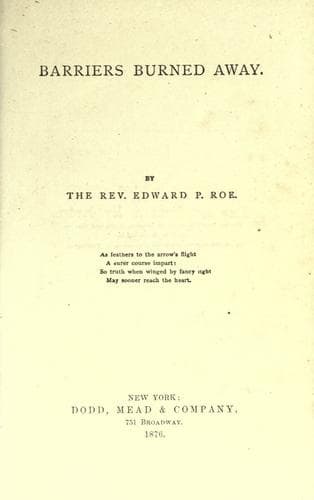
Chicago (Ill.) -- History -- To 1875 -- Fiction; Fires -- Fiction; Great Fire, Chicago, Ill., 1871 -- Fiction; Historical fiction
Dennis set about preparations for their simple morning meal so deftly
and easily as to show that it was no unaccustomed task. A sister older
than himself had died while yet an infant, leaving a heartache till
he came--God's best remedy. Then two sisters had died after his day,
and he had been compelled to be to his mother daughter as well as son,
to make himself useful in every household task. His father had been
wrapped up in useless inventions, vain enterprises, and was much away.
So mother and son were constantly together. He had early become a great
comfort and help to her, God blessing her in this vital respect, though
her lot seemed hard in other ways. Thus, while he had the heart and
courage of a man, he also had the quick, supple hand and gentle bearing
of a woman, when occasion required. As proof of his skill, a tempting
meal from the simplest materials was placed smoking on the table, and
the little girls were soon chatting contentedly over their breakfast.
In the meantime the wife within had drawn near her dead husband and
taken his cold hand. For a while she dwelt on the past in strong and
tearful agony, then, in accordance with long-established habit, her
thoughts went forward into the future. In imagination she was present
at her husband's reception in heaven. The narrow, meagre room melted
away, and her feet seemed to stand on the "golden pavement." The
jubilant clash of heavenly cymbals thrilled her heart. She seemed
taking part in a triumphal march led by celestial minstrelsy toward
the throne. She saw her husband mount its white, glistening steps, so
changed, and yet so like his former self when full of love, youth, and
hope. He appeared overwhelmed with a sense of unworthiness, but his
reception was all the more kind and reassuring. Then as he departed
from the royal presence, crowned with God's love and favor forever,
though he had all heaven before him, he seemed looking for her as that
he longed for most, and her strong effort to reach his side aroused
her from her revery as from a dream. But her vision had strengthened
her, as was ever the case, and the bitterness of grief was passed.
Imprinting a long kiss on her husband's cold forehead, she joined her
family in the outer room with calm and quiet mien. Her son saw and
understood the change in his mother's manner, and from long experience
knew its cause.
We need not dwell on what followed--preparations for burial, the
funeral, the return to a home from which one who had filled so large
a place had gone--a home on which rested the shadow of death. These
are old, familiar scenes, acted over and over every day, and yet in
the little households where they occur there is a terrible sense of
novelty as if they then happened for the first time. The family feel
as if they were passing through a chaotic period--the old world breaking
up and vanishing, and a new formation and combination of all the
elements that make up life taking place.
Public-domain text, read in full here on John Shaqi.
Reviews
Reviews
No reviews yet
Be the first to share your thoughts on this work.
Join the Discussion
Join the discussion
Sign in to leave a comment or review.
Sign InorCreate an account